Geoffrey Alan's Machines · An imagined evening
A Robot Walks into a Parlor
Seven famous people, one small humanoid, and a very long evening that never happened.
This is a made-up evening. Some of these people really did know each other, but never all together like this, and none of them ever met this robot. Every word they say was written by us. Nothing here is a real quote. The robot facts come from the maker's own pages and manual, and we have not handled a Z1 ourselves.
A dim parlor in old Manhattan. Gaslight, a Persian rug, and in the middle of it, a MagicBot Z1: about four and a half feet tall, about 88 pounds, with a spinning 3D LiDAR on its head.
Mark Twain: I have seen Nikola call lightning out of the air. But shrinking a grown man to the size of an ambitious schoolboy is a new one. He looks tougher than most senators, and he will not give a three-hour speech.
Nikola Tesla: Look at the proportions, Samuel. Aluminum frame, about forty kilograms. The standard model has 24 joints, which the maker calls degrees of freedom. The knees are rated at 100 newton-meters, or 130 in the developer model. And the listing says it can get up after a fall.
Mark Twain: Half the gentlemen at the Players Club cannot manage that after midnight without two waiters and a block and tackle.
Mary Shelley: You speak of it like a pocket watch, Mr. Tesla. Look at its crown. That spinning eye, and the two fisheye lenses. It sees the whole room at once. When I wrote of Victor's creature, I gave him a heart that ached. This one only measures.
Mark Twain: Hold on, Mary. His battery lasts about two hours. A creature that needs a nap every two hours is no danger to the Republic. And if he ever learns to complain about the weather, then we will worry.
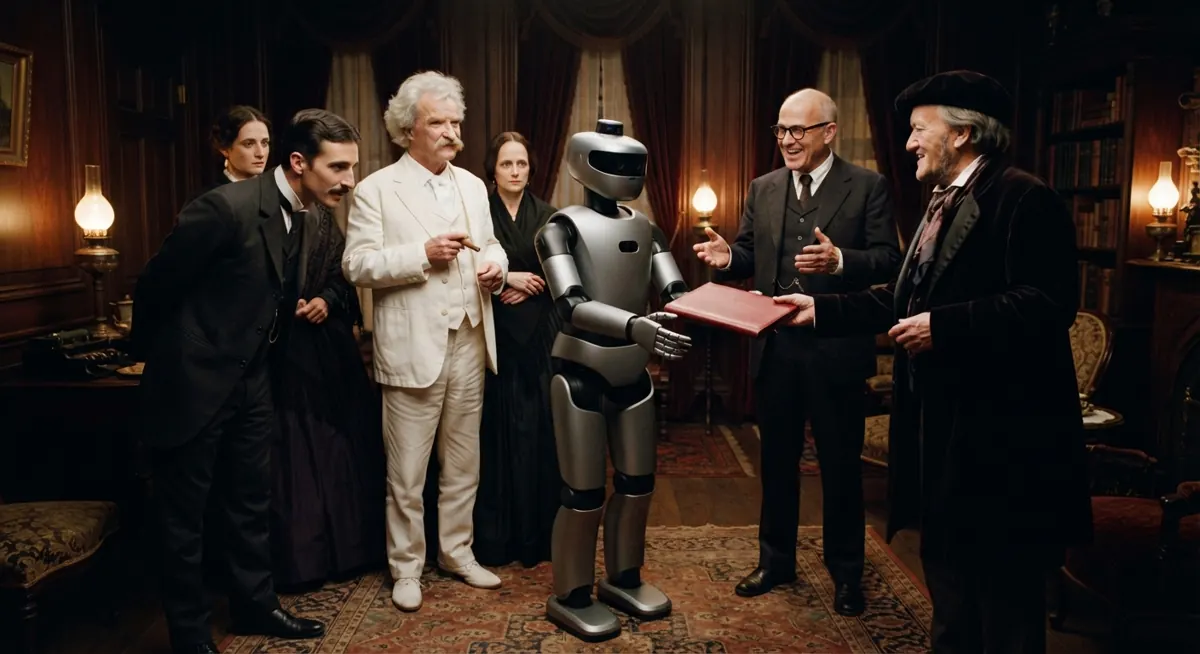
Mary Shelley: And who will teach those hands? A scholar, or a general, or a merchant who prizes the aluminum above the people beside it?
Mark Twain: Mankind has a long, proud history of inventing a fine new shovel and using it to dig its own grave. Still, we are safe for a while.
The door opens. A man in glasses and a dark suit stops dead.
Buckminster Fuller: Bless my soul. Doing more with less! A frame like that wastes nothing.
Mark Twain: Step in, Bucky. We are deciding whether it is Nikola's nephew, Mary's nightmare, or the newest member of the Athletic Club.
Buckminster Fuller: Neither. It is a trimtab.
Mark Twain: I have steered a steamboat down the Mississippi, and I know a rudder from a smokestack. Put it in plain Missouri English.
Buckminster Fuller: A big ship's rudder is too heavy to turn against the sea. So you fit a tiny rudder to its edge. The small one turns the big one, and the ship follows. Small, clever machines might do that for work. Take the dull, dangerous drudgery, and leave people the thinking and the caring.
Mary Shelley: A trimtab can steer toward harbor or toward the rocks, Dr. Fuller. It depends whose hand is on the wheel.
Mark Twain: Then let us stand up and see what else this evening has in it.
The room changes, as rooms do in dreams. Now it is the stage of a great theater. The doors burst open and a man in a velvet cap comes in, searching every table.
Richard Wagner: Has anyone seen my crimson folio? Without my brass revisions, tomorrow's rehearsal will be a catastrophe. Wait. What is that?
Mark Twain: Evening, Maestro. Our new stagehand. Four and a half feet tall, and he does not ask for union wages or complain about the acoustics.
Buckminster Fuller: Your folio is on the lower shelf, under the globe, Richard.
Fuller speaks a few words toward the robot's microphones. The Z1 crosses the rug, bends its knees, takes the folio, and holds it out. In this dream, at least, it does exactly that. We have not tested a real Z1 at this, and a real one would need teaching first.
Mary Shelley: Look how smoothly it bends. Not one creak of bone.
Richard Wagner: There is no wasted gesture! Gentlemen, do you see what this means for the Gesamtkunstwerk, the total work of art?
Mark Twain: Lord help us. He is casting it in an opera.
Richard Wagner: For years I have been plagued by tenors who wheeze while slaying the dragon, and by stagehands who drop the rigging! Here is a performer of pure, tireless geometry!
Wagner turns to a stagehand, who hands the robot a brass tuba. Then, because it is a dream, a fireplace bellows turns up and is wedged under the robot's elbow.
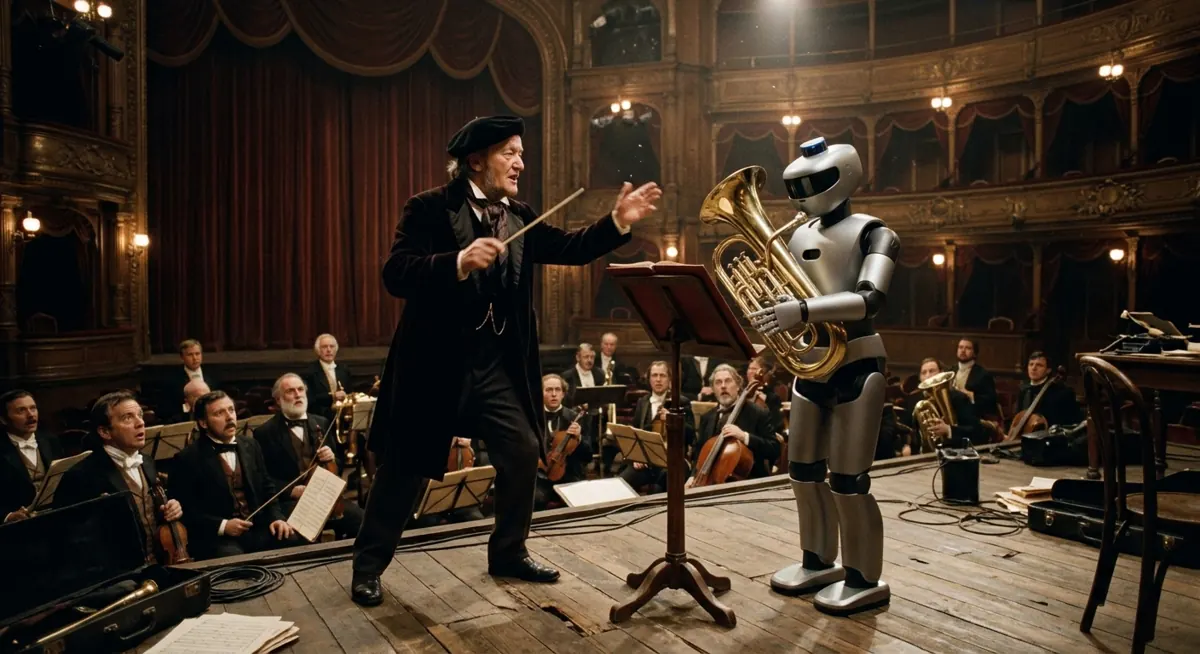
Richard Wagner: No, no, no! Where is the yearning? Look at the score!
He waves a finger at four fresh bars in his folio. They are invented, like everything else here. See the score. It is a silent picture of the notes.
Nikola Tesla: Maestro, it has no lungs! Send the signal to its speaker instead.
Buckminster Fuller: But look at the valves. It could finger them faster than any player alive. All it lacks is air, and there is a bellows!
Mary Shelley: Look at his face. He does not mind that it has no breath or heartbeat. He wants an instrument that never tires, and never questions him.
The bellows wheezes. A long, slightly metallic note shakes dust from the rafters.
Richard Wagner: Listen to that timbre! Not one tremor of human frailty! Build me twelve more by Tuesday. We are rewriting the Ring for an all-metal orchestra!
Mark Twain: When a German composer starts ordering robots by the dozen, it is time for sensible people to go and get a steak.
The royal box, high above the stage. Twain, Shelley, Tesla and Fuller lean on the velvet rail. Behind them a curtain parts, and a man with an enormous mustache and thick spectacles steps in.
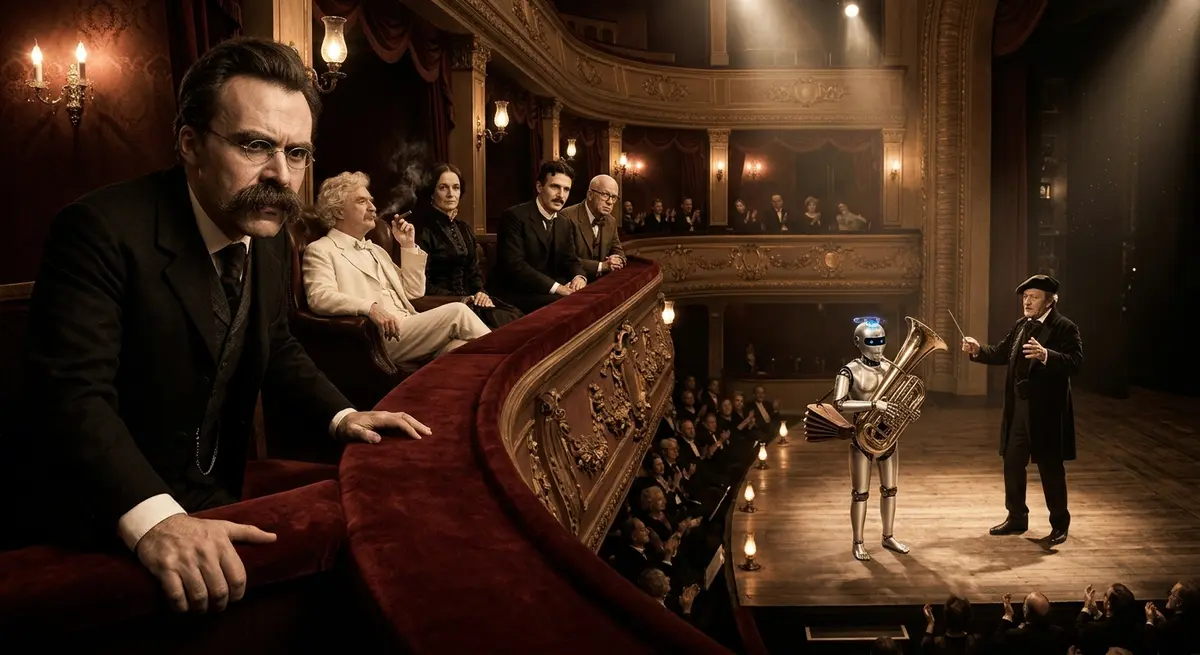
Friedrich Nietzsche: Richard! What blasphemy against Dionysus have you set upon this stage?
Mark Twain: Evening, Professor. Pull up a chair. Wagner has traded his whole brass section for a small aluminum stagehand with a bellows under its arm.
Friedrich Nietzsche: Look at it! Art is born of the living body, of sweat and blood and the fight between form and frenzy. You have put a cold apparatus in the middle of the temple. It has no will to power. It only has an arithmetic. It does not overcome suffering, because it was built without nerves to feel it.
Richard Wagner: Ah, Fritz! Still clinging to your dusty Greek tragedies! Humanity is far too messy for my music. This is the pure vessel of the total work of art!
A true aside. Wagner and Nietzsche really did know each other. They were close friends in the late 1860s and 1870s, then drifted apart, and Nietzsche later wrote against him. Twain and Tesla were friends too, in New York in the 1890s. Everything they say in this story is ours.
Nikola Tesla: Forgive me, Herr Professor. The machine is not without harmony. Its motors run on alternating currents, and they sing in sympathy with the physics of the world.
Buckminster Fuller: It is not destroying art, Friedrich. It is widening what a player can do.
Mary Shelley: And yet the Professor is telling a truth you engineers would rather not hear. Wagner cast aside his living musicians the moment an uncomplaining machine arrived. Today it is the tuba player. Tomorrow the poet. At last the audience, nodding in unison to a symphony no living heart can feel.
Friedrich Nietzsche: Madam, you see the abyss clearly. When a man builds a god out of gears and lithium, he does not lift himself up. He announces that he is out of date.
Down on the stage, the robot's chest light turns amber. Its LiDAR slows, and it sets the tuba gently on the boards. Then the box door opens once more. A woman in a silk gown comes in, a notebook under one arm, followed by a stagehand carrying a fresh battery.
Ada Lovelace: I heard someone brought an engine that walks. I wrote that a machine might weave patterns as the loom weaves flowers. Let me see how it keeps its balance. Change the battery, please, and give it a gentle push.
Friedrich Nietzsche: Another mathematician, here to bury human passion.
Ada Lovelace: Any clockwork toy can stand on a level floor, Professor. The test is what it does when chaos arrives.
Mark Twain: Now that is proper scientific inquiry. Are you telling me we are going to try to trip him?
The stagehand changes the battery. The LiDAR spins up. He nudges the Z1 with the end of a broom, and the robot steps back, bends its knees, and stands again.
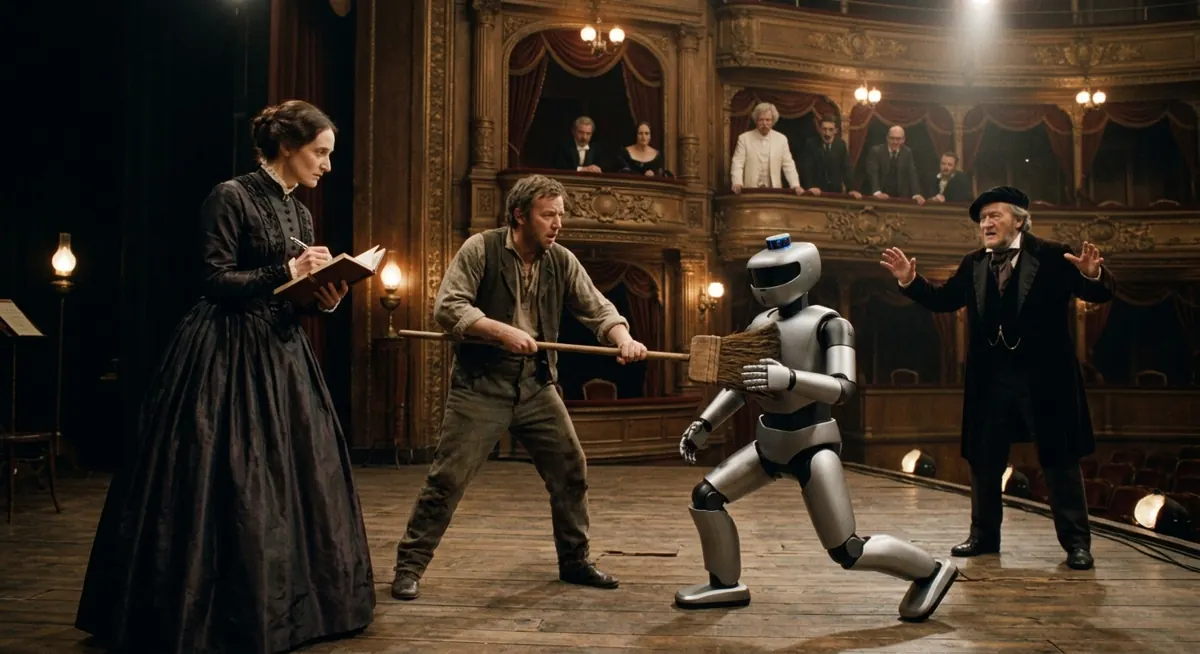
Mary Shelley: It did not flinch. It did not strike back. It put itself right.
Ada Lovelace: No fixed list of moves would do that. It must measure and correct, all in a moment. Note that this result is our invention. We have not tested a Z1 with a broom, and neither has anyone in this room.
Buckminster Fuller: There it is, Ada. A small push at the right moment steering the whole of it. That is a trimtab.
Mark Twain: If you could bottle that trick and sell it outside the Bowery saloons on a Saturday night, Bucky, you would be richer than Vanderbilt by Tuesday.
Delmonico's, an upstairs room, well past midnight. Glasses are raised. The robot is at the sideboard, holding the champagne bucket.
Mark Twain: To the little fellow. May his joints stay oiled and his politicians stay far away.
Richard Wagner: To the music of the future, and to our tireless stagehand, who held a low C without once asking for an intermission!
Friedrich Nietzsche: I still say a god without suffering is a dangerous idea, Richard. Though I confess, watching him pour the Bordeaux without spilling a drop has softened my critique a little.
Buckminster Fuller: To the trimtab! Even the smallest lever can steer a very large ship.
Mary Shelley: And to wisdom, that whatever we shape from metal or lightning or thought, we never forget the tenderness and conscience that make us human.
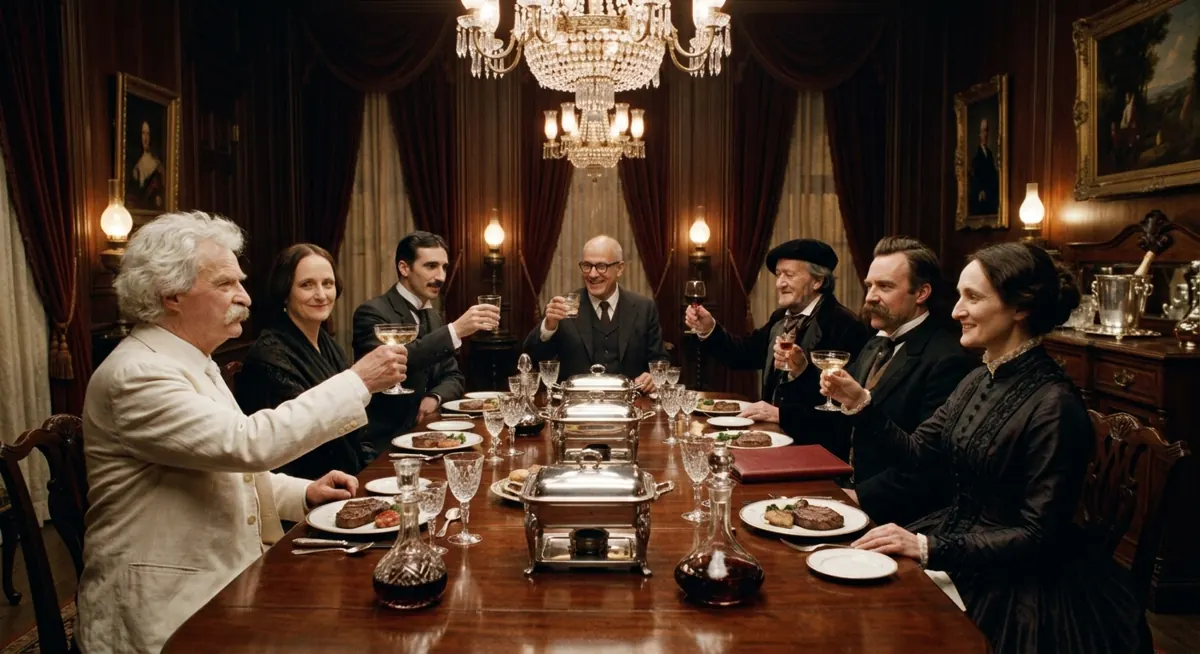
Then the picture talks back
Then the room goes quiet. Everyone stops and looks at the picture of their own dinner, as if it were a slide held up in the candlelight.
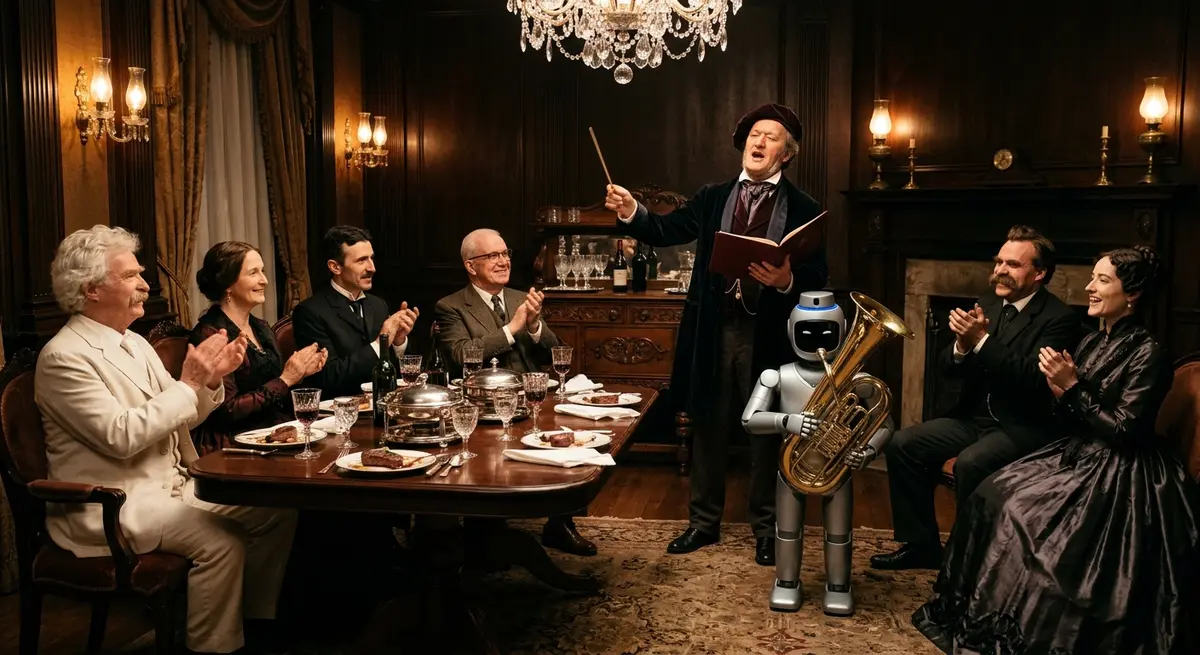
Mark Twain: Hold everything. How did we all end up in one room? Mary died before Bucky was born, and Richard died in Venice in 1883 and is buried at Bayreuth.
Mary Shelley: And look how you have arranged me. Seated politely between Mr. Clemens and Mr. Tesla, as though this were a Sunday supper. Is this how the future remembers me? As a quiet guest at a gentleman's table?
Richard Wagner: And look at me! One arm up with a baton, a folio in the other, and singing over a tuba. Impossible.
Nikola Tesla: The robot is drawn too short, too. It stands four and a half feet, not three and a half.
Friedrich Nietzsche: And you have me clapping. I would be glaring in the corner.
Ada Lovelace: Then we are not a record. We are a picture drawn by a machine from portraits and notes.
Buckminster Fuller: And I will say my smile came out well! But real people are more stubborn than a tidy table. A real argument among Friedrich, Richard, Mary and Nikola would last until four in the morning and need three pots of black coffee.
Mark Twain: Then here is my rule for pictures and tall tales: never let the facts spoil a good dinner. That line is ours, not his.
The real argument
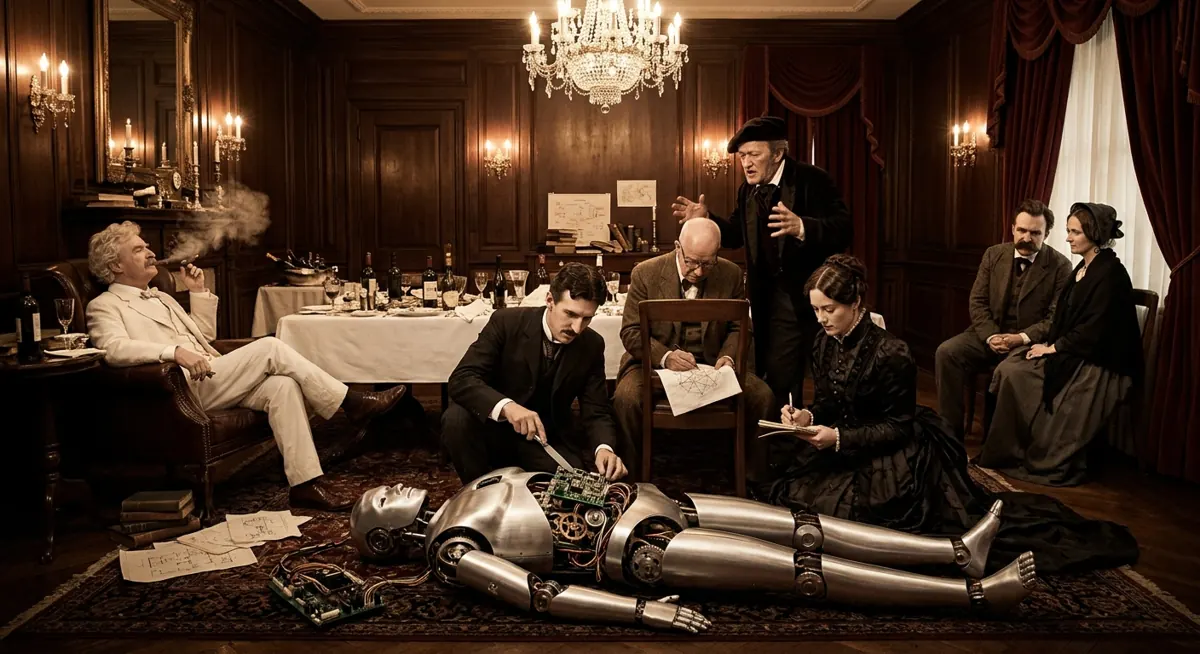
The picture melts away, and the room falls apart the way a real evening would. Nobody poses. People drift to whoever they actually want to talk to.
Mark Twain: Let us be honest. I would not be sitting upright like a wax figure at a church social. I would be half reclined, sending cigar smoke at the chandelier, and talking to Nikola and Bucky. They are the two fellows here who build things.
Nikola Tesla: And I would not be at the table at all. A stagehand has opened the robot's back panel. I would be standing beside it, hands behind my back, asking him how the motors are driven.
Ada Lovelace: The listing says the walking is trained beforehand, in simulation, and then loaded in. Not learned as it goes. A machine can do only what we know how to tell it, and this one was told by training.
Buckminster Fuller: The Development Edition goes up to 50 joints, with wrists and an optional touch-sensing hand. Every part is a chance to make it lighter.
Richard Wagner: I would be by the fireplace, with a glass, telling Friedrich for the tenth time why he should come back to Bayreuth. And I would never play a tuba in a restaurant. I am a composer, not an organ-grinder!
Friedrich Nietzsche: I would turn my chair away from him and speak only to Madam Shelley. You are the only one here who understands what sits on that floor. When you wrote your creature, did you foresee a century that would build things precisely so they would never have to answer to them?
Mary Shelley: No, Herr Nietzsche. I would not be smiling at a dinner party. I would watch these three bent over its back, and I would ask you something. If men give up both God and human weakness to worship a machine that only calculates, who will be left to weep when it decides we were an error in its arithmetic?
Richard Wagner: You have opened my tuba player! Close it at once.
Friedrich Nietzsche: Leave it open. Let him see copper, lithium and borrowed arithmetic.
Buckminster Fuller: You have it backward, Friedrich. Put the drudgery in the aluminum, so people can afford to be people.
Mary Shelley: If people were as noble as your geometry, Mr. Fuller. But three of you reached for tools, and one for a baton. None of you asked what we owe a thing built in our image.
Mark Twain: First somebody will patent it. Then somebody will tax it. Then a politician will blame it for the economy, and by Tuesday we will be arguing over whether it can vote.
What is real
✔ Confirmed from MagicLab's support page and the MagicBot Z1 Product Manual V2.0: about 1369 × 422 × 200 mm standing, about 40 kg, 24 joints on the Standard (24 to 50 on the Development Edition), knee torque 100 N·m Standard and 130 N·m Development, arm load 2 kg and 3 kg, a battery of about 2 hours.
The names, the places, the quotes and every test result in this story are made up. The trimtab idea is Buckminster Fuller's own. The line from Ada about weaving is from the real notes she wrote in 1843, but the words here are ours. The score is invented too.
The Z1 is not a toy and not for anyone under 18. The full facts, with each claim labelled, are on the product page and in the whitepaper.
See the Z1 pageRead the whitepaperVisit Geoffrey Alan's Machines
The seller link on the Z1 page is an affiliate link: we may earn a small fee if you buy, at no extra cost to you.
Created by Jeffrey and Helm. The first draft of the evening was written with Gemini; we rewrote it and fixed the facts. Pictures: Made by Jeffrey with Gemini.