Geoffrey Alan's Machines · Imagined evening
What the Bin Can’t Tell
Is a push sweeper a machine? Four famous people, one hand-push sweeper, and a small argument that is harder to win than it looks.
This is a made-up evening. Babbage and Lovelace really did work together in the 1840s. As far as we know, Mark Twain and Buckminster Fuller never met them, or each other. Every word they say was written by us. Nothing here is a real quote. The sweeper facts come from the seller's own listing, and we have not touched one.
Created by Jeffrey and Helm
The evening
Our own drawing. Not a product photo.
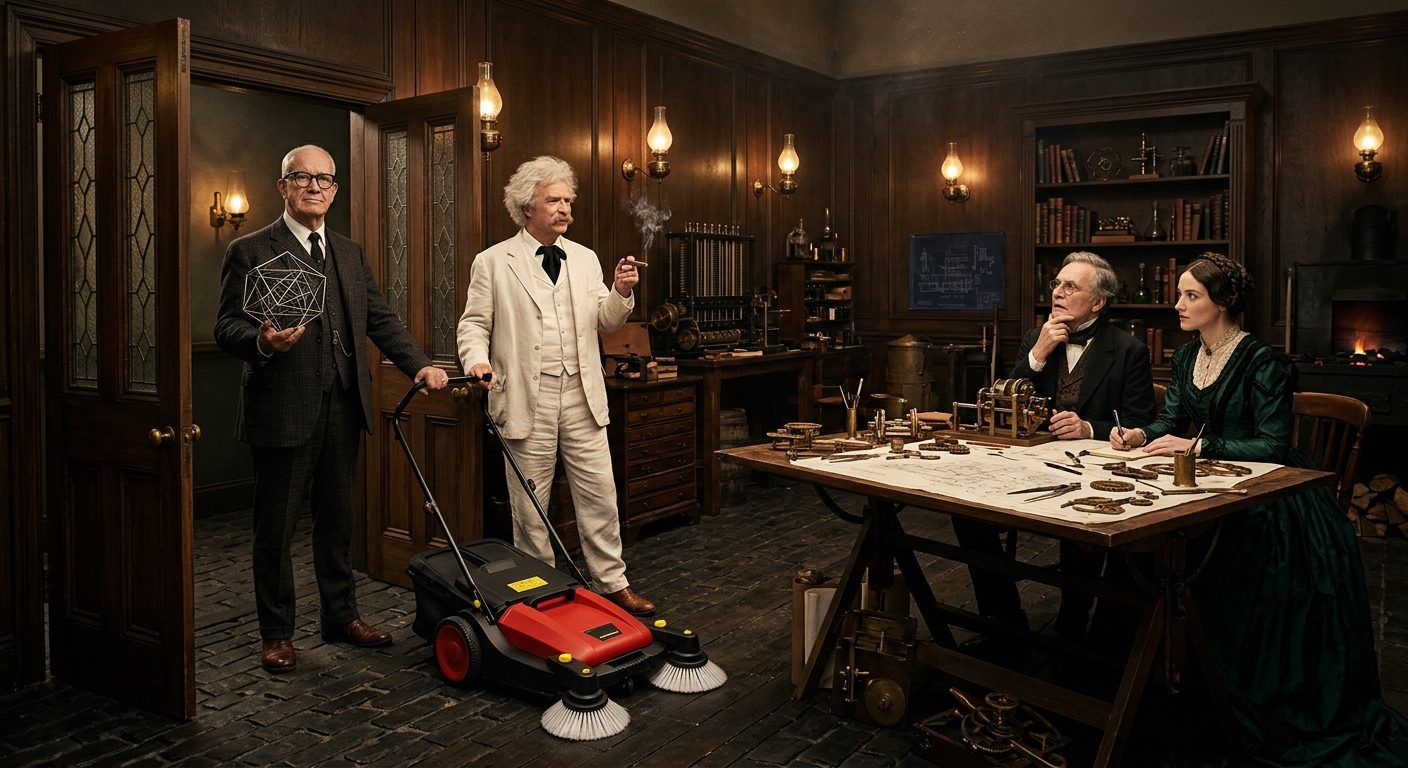
A workshop in London, late in the evening. One gas lamp, a drawing table buried in brass wheels, and a long strip of paper covered in numbers. Charles Babbage is arguing with a gear. Ada Lovelace is not arguing with anything; she is writing a table, one careful line at a time, for a machine that does not exist yet.
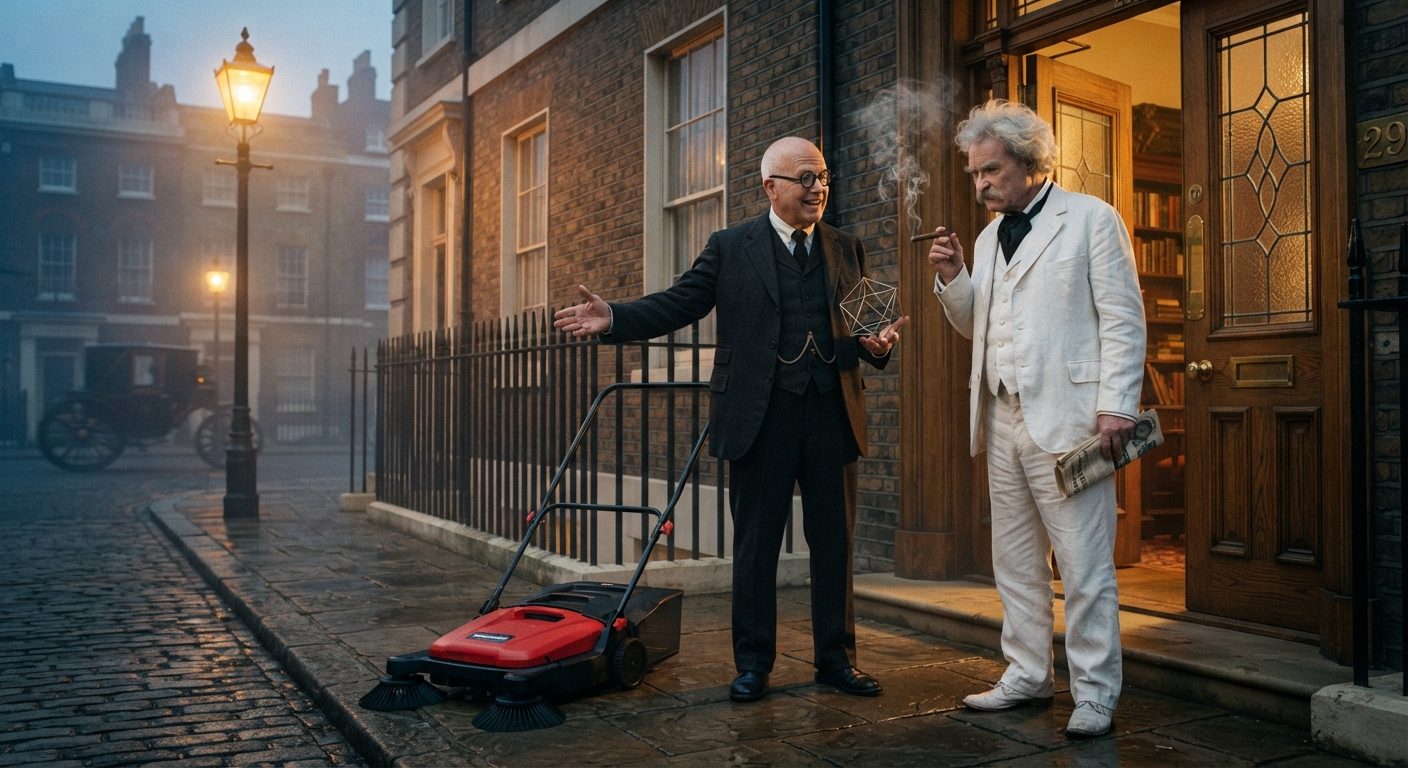
The door opens without a knock. Two men come in out of the dark. One wears a white suit and a cigar. The other wears round glasses and carries, with great care, a long thing wrapped in paper. Between them it looks like a very tall umbrella that has been to university.
“Gentlemen,” says the man in white, nodding at Ada, “and madam. We have come on a matter of definition. Samuel Clemens. This is Mr. Fuller. He does the thinking. I do the talking, and a little of the lying.”
Fuller unwraps it. It is a floor sweeper with a long handle, a boxy body, a wheel at the back and a round brush at the front. He reads from a sheet. “A walk-behind hand push floor sweeper. Twenty-five and six-tenths inches of sweeping width. A five-gallon waste container. Angle and height adjustable.”
“Marked down about seventy percent,” says Twain, “which in my experience means somebody once thought it was worth three times as much and found out otherwise.”
Babbage puts down his gear. “And you ask me whether it is a machine.”
“We ask,” says Fuller, “whether it is a machine at all, or only a stick with ambitions.”
Babbage walks around it twice. “A machine takes a power and turns it into work through a mechanism. Where is the engine? Where is the steam?”
“Standing right there,” says Twain, pointing at Fuller. “He is called a man. Burns less coal than a locomotive and complains more.”
Ada has stopped writing. She crouches by the wheel. “The wheel turns as it is pushed. I would guess the wheel turns the brush. The listing says nothing about that, so I am only guessing. But if it does, then the person walking is the motor, and the little arrangement of wheel and brush is the machine.”
“Which is to say,” says Fuller, “the walker supplies the push and the sweeper supplies the order.”
“Order,” says Babbage, suspicious. “A machine must do its work in a fixed order. This has none.”
“It has one,” says Ada. “The wheel turns, the brush turns, the dust goes in the bin. That order was decided by whoever built it, long before anyone pushed. That is what a mechanism is: a decision made once and kept in brass. Or plastic.”
“But it decides nothing,” Babbage says.
“Neither does yours,” says Ada, gently. “Your engine does what we know how to order it to do, and no more. That is its glory, Mr. Babbage, not its shame.” (That is the idea in her real notes, put in our words. The words are ours.)
Babbage opens his mouth and shuts it again, which for him is a concession.
Twain lights the cigar he has been holding. “I will tell you about machines. I once put a good part of my fortune into a typesetting machine that was going to change the printing of the world. It set type beautifully, on a good day, once. I also patented a scrapbook that pasted itself, and the scrapbook paid me. The scrapbook had no motor, no engineer and no investors, and was the finest machine I ever owned. This sweeper has fewer parts than my typesetter had regrets.”
“Then you agree it is a machine,” says Fuller.
“I agree that it is honest,” says Twain. “That is rarer.”
Fuller takes off his glasses and polishes them on his sleeve. “I have spent a good deal of my life on one idea: doing more with less. This does a great deal with very little. A person’s walking becomes a clean floor. There is no battery to die, no screen to freeze, no app to update.”
“And the others?” asks Ada. “The ones in your shop.”
“Ah.” Fuller sets the sweeper upright. “A robot that maps a lawn and goes round it on its own. A robot that climbs the wall of a swimming pool. A bread machine with fifteen programs. These do a great deal of the deciding themselves. The sweeper decides nothing.”
“Then your question,” says Ada, “was never whether it is a machine. It was how much of the thinking lives in the machine, and how much in the one pushing.”
Babbage straightens his coat. “I withdraw my objection. I will not be thanked.”
Ada picks up her pen and adds a row to her table. Machine: yes. Thinking: none. Pusher: required.
Twain tips ash into a drawer of brass wheels that, fortunately, are not wired to anything. “Entered in the record,” he says, “as a machine. The only one in the whole shop that runs on breakfast.”
Ada has not quite finished. She looks into the bin. “Put one of my punched cards in front of it,” she says, “and it will sweep the card up as willingly as sawdust. It cannot tell which is which. Somebody has to.”
“That is what a bin is,” says Twain. “A place where nobody has decided yet.”
Twain looks at the clock, then at the sweeper, then at the four of them. “Gentlemen, madam. We have spent an hour on a dustpan.”
“An hour I might have spent on the Engine,” says Babbage. “The Treasury will not pay for it, and I am arguing about bristles.”
“Then say what you would rather be doing,” says Twain. “Each of you. The sweeper has earned that much. It made us ask.”
Ada answers first. “I would rather ask what a machine can work on besides numbers. In my notes I wrote that the Engine might act upon other things, if their relations could be put into symbols. I even wrote that it might compose music, if the rules of harmony allowed it.” (Those ideas are in her real notes. The words here are ours.)
“And I,” says Fuller, “would rather spend my life on doing more with less. I have a word for it, a clumsy one: ephemeralization. The sweeper is a very small example. A walker, a wheel and a brush do the work of a man on his knees with a pan.”
“I,” says Twain, “would rather find out why clever people believe in the newest gadget. I put a good part of my fortune into one, and I would like to know what I was thinking. Everything in this room is a gadget that somebody believed in. I want to know how believing works.”
Babbage says nothing for a moment. “I would rather finish the thing on that table,” he says at last, and nobody argues.
Twain wheels the sweeper into the corner, out of the lamplight. The four of them turn their backs on the floor and gather round the drawing table, where the real work is.
The line about breakfast is ours, not Mark Twain’s.
What is real
- Ada Lovelace’s notes on Babbage’s Analytical Engine were published in 1843. They include a step-by-step method for the engine to calculate Bernoulli numbers. The engine was never built, so the method was never run on it.
- Mark Twain patented a self-pasting scrapbook, the only one of his inventions that made money. He also invested heavily in the Paige typesetter, a machine that failed, and he was bankrupt by the mid-1890s.
- Buckminster Fuller was an engineer and designer, known for the geodesic dome and for the aim of doing more with less.
- The sweeper is described only by the seller’s listing. Its size, bin and adjustments are the seller’s words, and we have not touched one. The listing does not say how the brush is driven, so Ada’s guess about the wheel is only a guess.
Sources we read
- The Morgan Library on Twain’s inventions
- Twain’s Patent Scrapbook (University of Virginia)
- The Paige Compositor (Wikipedia)
- Note G, Lovelace’s algorithm (Wikipedia)
- Ada and the First Computer (University of Virginia, PDF)
- R. Buckminster Fuller (Britannica)
- Ada Lovelace (Computer History Museum)
- Ephemeralization (Wikipedia)
Part two: The Engine and the ObjectionSee the sweeper pageAll the machines