Geoffrey Alan's Machines · Imagined evening, part two
The Engine and the Objection
The same room, later. The question stops being about a sweeper and becomes about whether a machine can start something on its own.
This is a made-up evening. Babbage and Lovelace really did work together in the 1840s, and Twain and Tesla really were friends. As far as we know, nobody else here ever met, and Lovelace died in 1852, before Hopper or Turing were born. Every word they say was written by us, except two sentences marked as real. The list at the bottom says what is real and what is not.
Created by Jeffrey and Helm
The evening
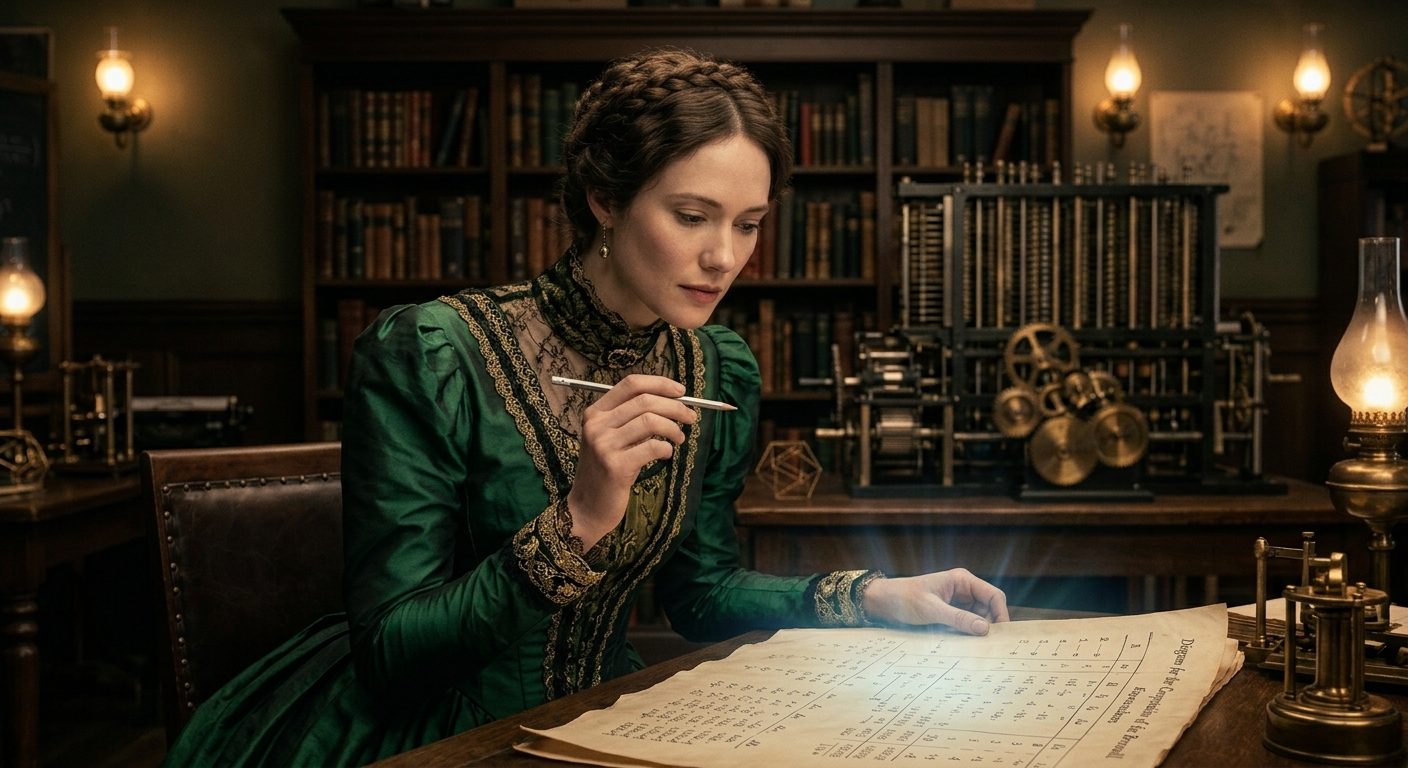
Later the same night. The sweeper has been wheeled into a corner, where it sits looking innocent. Fuller is measuring the floor tiles with a pocket tape. Ada Lovelace has spread her long table of numbers beside the drawing table. Mark Twain has stopped talking, which is rare, because he has noticed what is on the drawing table.
“That is the real machine, isn’t it,” says Twain. “Not the dustpan.”
“The Analytical Engine,” says Babbage. “It does not exist, Mr. Clemens. I have drawings, one fragment, and a great many letters to the Treasury.”
He explains it the short way. There is a Store, where numbers wait, and a Mill, where the arithmetic is done. The instructions come on punched cards, an idea borrowed from the silk looms of Jacquard. And the engine can choose which card to read next, depending on a result it has just worked out. “It looks at its own answer,” says Babbage, “and decides what to do next.”
Twain whistles. “And the Treasury asked what?”
Babbage’s jaw tightens. “Twice, once in each House of Parliament, I was asked: ‘Pray, Mr. Babbage, if you put into the machine wrong figures, will the right answers come out?’ I am not able rightly to apprehend the kind of confusion of ideas that could provoke such a question.” (That sentence is Babbage’s own. He wrote it down in 1864.)
“I have heard that question at every bank in Hartford,” says Twain.
Ada taps her table. “This is what we would tell the engine to do. A list of operations, in order, to calculate a series of numbers named for Bernoulli. I published it in 1843 with my notes. It has never run, because the engine was never built.”
A third man comes in from the dark, tall, careful, a little amused. Nikola Tesla bows to Ada and looks at the brass. “Magnificent,” he says. “And slow. A crank turns once a second. Electricity moves far faster than brass. What you want, Mr. Babbage, is a switch that never wears out. I do not have one to give you. Someone will have to build it.”
“Nikola,” says Twain, “once stood me on a platform in his laboratory and switched on a shaking machine. I will let him tell what happened next, since it is his version, not mine.”
“You were gone in ninety seconds,” says Tesla, “and you did not stop to say where.”
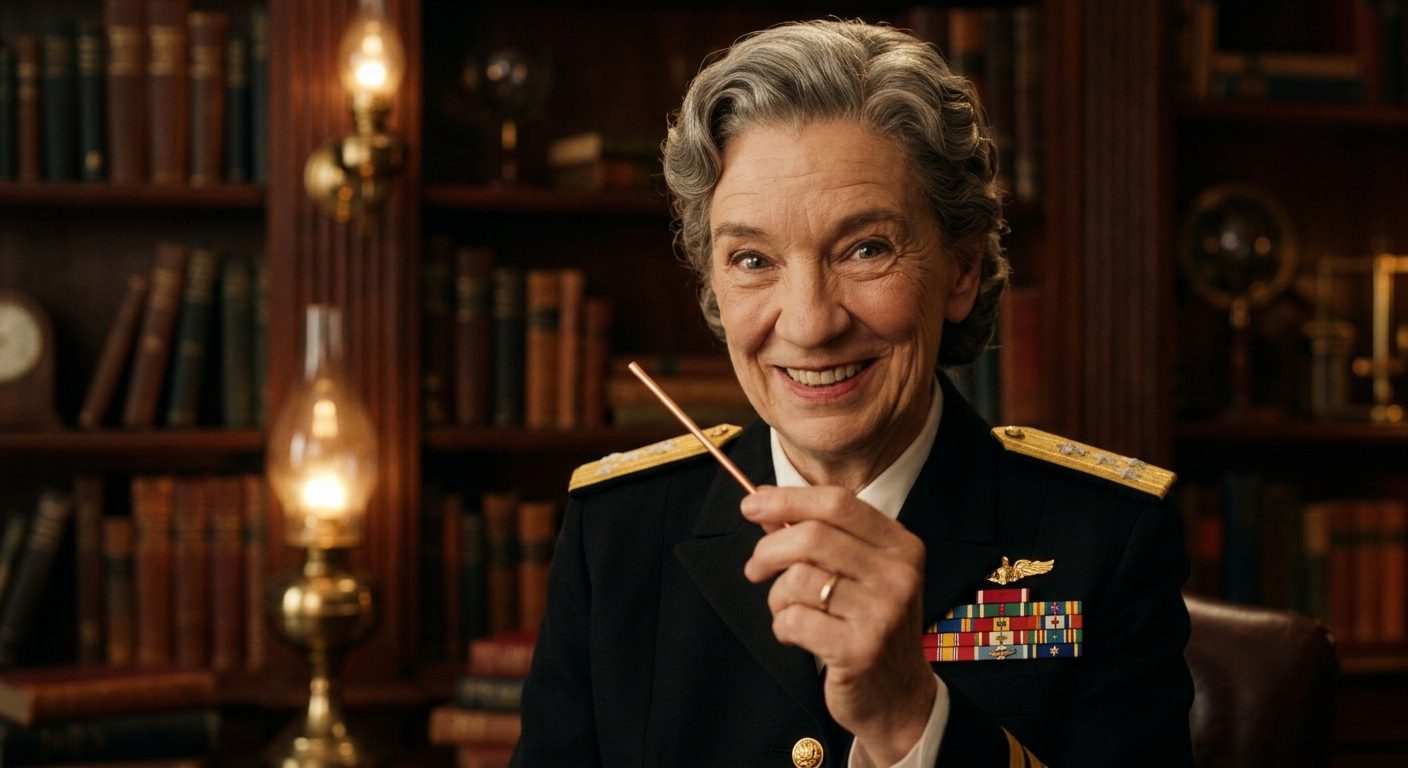
Two more people have come in, and they should not be able to. A woman in the dark uniform of a Navy rear admiral, carrying a small bundle of wire. A slight man in a tweed jacket with a pencil behind his ear.
“Hopper,” says the woman. “I programmed one of the first big computers, in 1944. It was fifty-one feet long and it was made of switches and brass shafts. Mr. Babbage, you would have recognised the family.”
“Turing,” says the man. “Miss Lovelace, may I read you one sentence of yours? I answered it in 1950, a century late.”
Ada folds her hands. “Read it.”
“‘The Analytical Engine has no pretensions to originate anything.’”
“I did write that,” says Ada. “And I meant it. The engine does what it is ordered to do.”
“In my reply,” says Turing, “I agreed with a colleague that the evidence you had did not show a machine could think for itself. It did not show it could not, either. And I said your engine was a universal machine, so with enough storage and speed it could behave like any machine of its kind. So it may have had that property, in a sense.”
“In a sense,” says Ada. “You keep a careful kind of door, Mr. Turing.”
“I try.”
“Then here is mine,” she says. “A thing that only does what it is told is not stupid. It is honest. If you ever build one that surprises you, I should like to know how you are sure the surprise did not come from you.” (That answer is ours, not hers.)
Babbage turns to the Admiral. “And does your machine surprise anyone?”
“Every Tuesday,” says Hopper. “Mostly by being wrong, because somebody wrote it down wrong. Which sends me back to your Treasury man. He was not so foolish as you thought. The right question was about the person putting the figures in. I spent my career on that question.”
Babbage opens his mouth for the second time that night and, once again, shuts it.
Hopper unwraps the bundle and lays one piece of wire on the table beside the brass gear. “This is a nanosecond. About eleven and eight-tenths inches: the most that an electrical signal can travel in a billionth of a second. I gave these to people for years, people who wanted faster machines and did not believe in distance.”
Babbage takes his brass calipers and measures it, because he cannot help himself. “Thirty centimetres, near enough.”
“So,” says Tesla, “the electric signal needs a foot of copper to cross a billionth of a second, and your crank needs a second to turn once.”
“Which is why the parts have to get small,” says Hopper. “Smaller parts, faster machine. That was the whole lesson of the wire.”
Twain looks at the corner, where the sweeper waits, then at the gear, then at the wire. “So the dustpan does what its wheel decides. The engine does what its cards decide. And the Admiral’s machine does what a man typed on a Tuesday. What have we been asking all night?”
“Whether a machine can ever begin something nobody told it to,” says Ada.
“I think that is the question,” says Turing. “I do not think we are finished with it.”
“Then I will leave it open,” says Twain, “and take my cigar outside.”
Nobody answers. On the table the wire lies beside the brass gear, one very short and one very old, each exactly as long as it is.
What is real
- Babbage and Lovelace worked together in the 1840s. Her notes, published in 1843, include a method for calculating Bernoulli numbers on the Analytical Engine. The Engine was never built.
- The sentence about “wrong figures” is Babbage’s own, from his 1864 memoir. The line “no pretensions to originate anything” is Lovelace’s own, and it is the sentence Turing replies to in section 6 of his 1950 paper. His reply is summarised above as the paper gives it.
- Mark Twain and Nikola Tesla really were friends. A famous photograph of Twain in Tesla’s laboratory was taken in the spring of 1894. The story of Twain on the shaking platform comes from Tesla’s retelling, not from Twain.
- Grace Hopper really did hand out short lengths of wire, about 30 centimetres (11.8 inches) long, each showing how far an electrical signal travels in a nanosecond. She began in the late 1960s, and the Smithsonian holds a bundle of them.
- The Harvard computer she worked on in 1944 was about 51 feet long, according to a 1944 magazine article.
- What did not happen: Hopper and Turing were never in Babbage’s workshop. Lovelace died in 1852 and Babbage in 1871. Tesla never met either of them. Everything else the characters say is ours.
Sources we read
- Smithsonian: Nanoseconds Associated with Grace Hopper
- Alan Turing, Computing Machinery and Intelligence (1950), section 6
- Babbage quotations, University of St Andrews
- Mark Twain Project at the University of Virginia: the 1894 photograph
- PBS NewsHour: five things about Nikola Tesla
- Wikipedia: Note G
- Flashbak, with the 1944 Popular Mechanics page on the Harvard calculator