Why Haberdasher? Small Wares and the Longest Road
The history of a word that nobody can explain, and the kind of goods it was made for
 Created by Jeffrey and Helm
Why Haberdasher?
The word is old, and nobody knows where it came from. It first turns up as a surname, Thomas Haperdasser, in 1280, and by the 1300s it meant a seller of small wares: the odd, useful things a person carries every day. Scholars still disagree about its exact origin, tracing it loosely to an Anglo-French term for assorted goods.
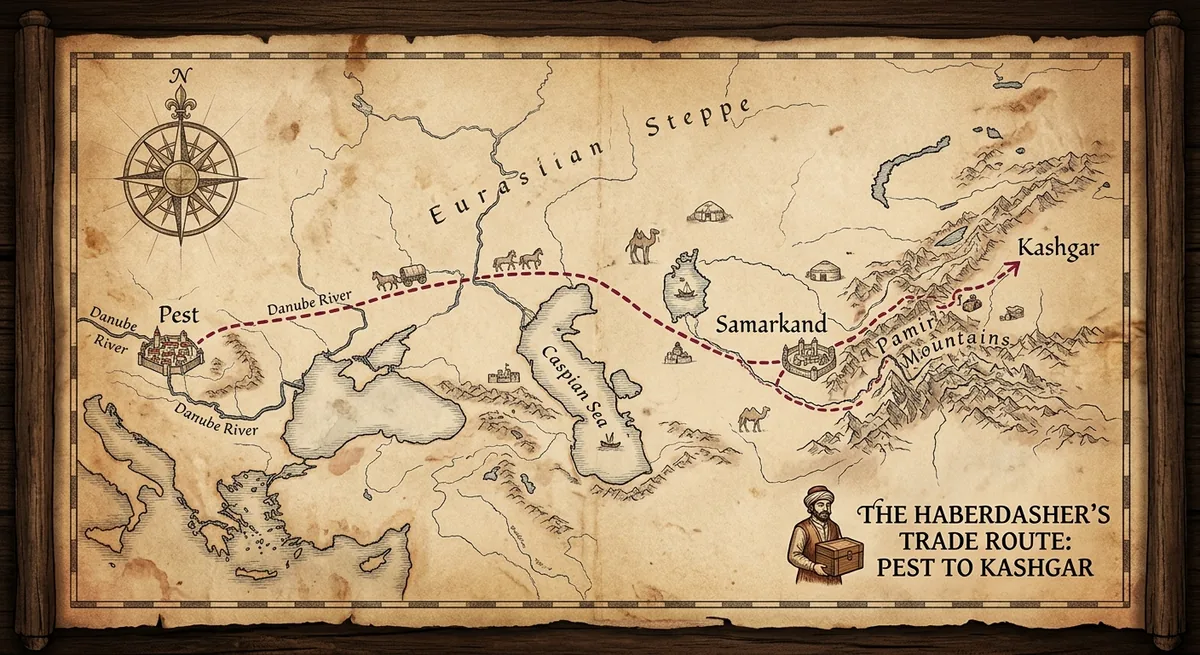
Before those wares ever reached an English market stall, they survived the longest supply line on earth. A trader setting out from the Danube docks of Pest toward the high markets of Kashgar crossed four thousand miles of steppe, desert, and Pamir mountain passes. Bulk cargo died on that road. The only things that made the journey were the things worth their weight: compasses, needles, oiled leather, flint, and blades built to be mended by firelight and carried in a coat pocket.
The word has no known parent
The earliest known use is that surname, written down in 1280 in the register of an Oxfordshire abbey. The dictionaries call its origin obscure. The usual guess is an Anglo-French word, hapertas, that may have meant a kind of cloth or a heap of small goods, but even that is a guess. One careful dictionary history points out that hapertas is itself a word with no known origin, so it explains one mystery with another. Another writer notes the spelling only settled around the middle of the 1500s, and that the word has nothing to do with dashing anywhere.
What a haberdasher sold
We have an actual shopping list. In July 1378 the stock of a London haberdasher named Thomas Trewe was written down. It held caps in wool and other colours, nightcaps and children’s caps, hats, laces, purses and paper. It also held spectacles, inkhorns, beads, chains, spurs, linen thread, parchment and a wooden block for shaping caps. Nothing on that list is large. Everything on it is the kind of thing a person needs on the way somewhere.
A trade of its own
The London haberdashers began as small-wares traders inside the Mercers’ Company, the guild of cloth and fine-goods merchants. City records from 1328 name three representatives of a newly separate group of haberdashers. By 1371 they had written rules for their own fraternity, and in 1448 Henry VI gave them a charter. In 1502 they were joined with the hatmakers, so for a time there were two kinds of haberdasher: those who sold hats and those who sold small wares. The company still exists, and its present charter dates from 1578.
The meaning kept drifting. Early on the word named a seller of a wide mix of goods, rather like a general store. Later the hat sellers took it for a while, and the sellers of sewing and dressmaking supplies split off. Today in Britain a haberdasher sells buttons, ribbons, needles and thread, while in the United States it means a seller of men’s clothing and accessories. Nobody fully knows why the two countries went different ways.
The long road
Now back to the trader on the map. Kashgar was the midpoint of the old Silk Route, where the northern and southern trails met again at the foot of the Pamirs, mountains with peaks above 7,500 metres. Caravans crossing the high passes followed narrow rock ledges around 4,500 metres up, through snow, avalanches and falling rock, and they went on mainly for the promise of large profits.
Pest itself was a market town. German merchants developed it into a trading town on the Danube, which was the great river thoroughfare of the country. A charter of 1244 even made foreign merchants offer their goods for sale there before taking them further, though the town lost that privilege within a few decades, as trade shifted toward Buda across the river.
Here is the correction we owe you. The trader on our map is one figure standing in for many. Historians agree that few people travelled the whole Silk Road: goods moved in a staggered chain, passing from merchant to merchant, and each handoff added to the price. The same reasoning explains our cargo. Overland transport was so expensive that only goods with a lot of value in little weight were worth carrying far, which is why silk, spices, gems and metals were the famous loads, and why bulky goods stayed close to home.
Our lens: the four thousand miles is our own estimate for a winding road. In a straight line, Pest to Kashgar is about 2,800 miles by our own great-circle calculation, and a real route would be longer. The cargo list at the top (compasses, needles, oiled leather, flint and blades) is our own picture of what a coat pocket would hold, not a record of a real manifest. The sources support the principle, that the pocket-sized things travel best, and not that list.
Why we named the shop this
That is why a shop for travellers took the old word. Godfrey Goes Haberdashery is our small shop of useful things for people on the go: a gentleman’s kit for the road, beginning with projectors small enough for a coat pocket, then gifts and curiosities. The word is as unexplained as ever, but the idea behind it has survived seven hundred years: carry little, carry well, and carry what can be mended.
Notes on how this was made
Created by Jeffrey and Helm. The map was made with Gemini. The research was done with MoE, a mixture of expert research agents, and every fact above was read on the pages listed below. The map is an illustration: it is not to scale and it does not claim to follow a real surveyed route.
Where these facts come from
Every claim above was read on these pages on 13 November 2026. The drawings, and anything marked as our lens, are ours.
- Haberdashers, Merriam-Webster: the 1280 surname and the obscure origin
- Haberdasher, World Wide Words: meanings, spelling and the two senses today
- Haberdasher, Wikipedia: small wares, mercers, British and American use
- The earliest origins of the Haberdashers, Haberdashers’ Company: 1328, 1371 and the 1378 stock list
- History, Haberdashers’ Company: the 1448 and 1578 charters
- Haberdashers’ Company, Origins: small wares, and the 1502 union with the hatmakers
- Silk Road, Britannica: few travelled the whole route, goods passed through middlemen
- Silk Road Opens, EBSCO Research Starters: trade passed from merchant to merchant
- Silk Road, Wikipedia: never a single route, and few travelled its whole length
- The Silk Roads, AP World History review: why only goods of high value for their weight were worth the journey
- Budapest, Britannica Kids: Pest as a trading town
- Budapest: The History of a Capital, Ságvári (ed.), 1975: Pest, the 1244 charter and the Danube
- What is the Silk Route? UNESCO: Kashgar, the Pamirs and the high passes