Music coil on a farmstead
 Created by Jeffrey and Helm
Picture a piece of land you do not own yet. There is a gravel pull-off, a shed that is only an idea, and a porch that is only a plan. This story is about the very first light on it, and a small one that is just for fun: a music coil that plays your songs while a thin arc of light dances to them.
What the listing says
- What it is
- A desktop music box that plays over Bluetooth 5.0 or an AUX cable, with a sound-reactive plasma arc as a display. This is the seller's description.
- Size
- 17.3 x 11.5 x 9.5 cm, from the seller's description. The packed box is listed at 15 x 11 x 10 cm and 0.42 kg.
- Made for
- A desk, a shelf or a table: something to look at while the music plays. The seller says to keep it indoors, or dry and under cover.
- What the seller says about safety
- The seller says it is CE certified and lists a 48V output. We have not seen the certificate, and we have not checked how much power it draws or what the seller's warnings say.
Read the safety notes first
A big Tesla coil is a different animal. The physics group at UC Santa Cruz keeps a safety page for its large demonstration coil, and it treats the thing with real respect. This product is a small desktop device, and the seller's page should say what it does and does not do. Until you have read it, do not assume anything: not that it is safe for outdoors, not that it is safe near a pacemaker, a young child, a pet or a heart monitor, and not that it can sit near anything that burns. Keep it dry and keep it away from paper and fabric.
The plasma is hot. Richie Burnett, who builds singing coils, writes that it will damage skin in milliseconds, and a continuous arc makes a lot of ozone. Our plain advice: keep skin, fingers and held objects away from the arc, keep paper and fabric clear of it, and run it in a room with fresh air.
How a coil works is explained just below, in plain words.
How a coil sings
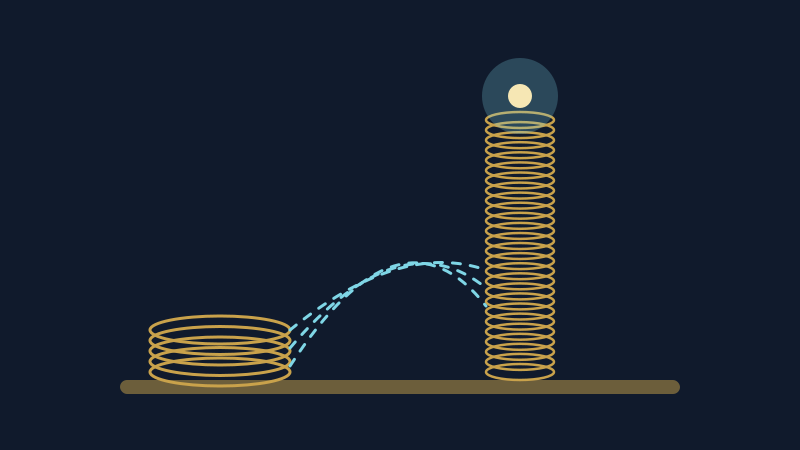
The old idea first. A Tesla coil is a resonant transformer, designed in 1891. It has two tuned circuits, a primary and a secondary, set to the same frequency, with air in the middle instead of iron. The two are only loosely linked, so energy passes back and forth over many cycles and gathers in the secondary: only about 5% to 20% of the primary's field passes through it. The result is very high voltage at low current and high frequency, and the Georgia Tech physics book gives the output as roughly 50 kHz to 1 MHz. Live Science compares the timing to pushing someone on a swing.
How an arc makes sound
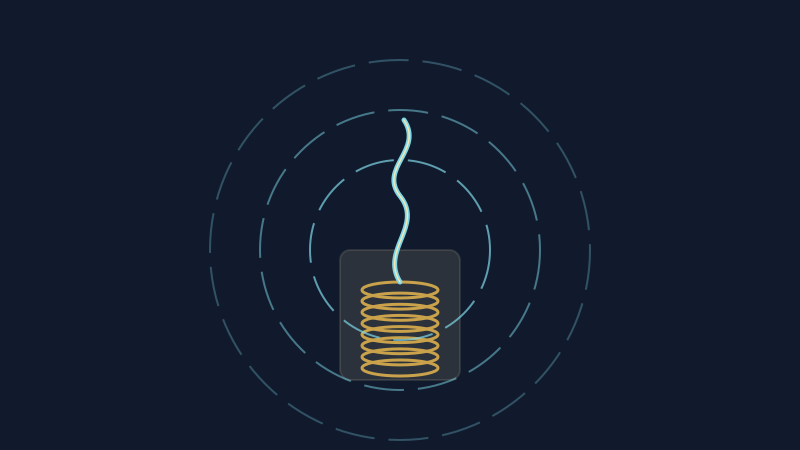
A singing coil is a coil whose arc is switched in time with music. Changing the power fed to the arc changes how hot the air around it gets: more power makes it hotter and larger, less makes it cooler and smaller. The air swells and relaxes, and that moves the air around you as sound. It is a drum made of air, with heat for the beat.
Why it is not hi-fi
Solid-state coil drivers are limited to on and off, so the sound is square-like rather than smooth: low fidelity, reminiscent of an analog synthesizer, says Wikipedia. Burnett says his own plasma speaker will never win any awards for efficiency. Expect a buzzy, synth-like voice, not a studio one.
Where the small box fits
In our reading, both turn fast-changing electricity into something you can see and hear. The big coil does it with two tuned circuits trading energy. The small box, as far as the listing says, drives an arc in time with the music. The seller does not call it a Tesla coil, and we do not either. We have not tested it, so this describes singing coils in general and not this product.
Two ways of looking
Our lens, not a finding: the physics above stands without these. In the five phases of Wu Xing, fire is the arc, water the flowing charge, metal the copper, earth the steady base, and wood what grows from a signal: the song. In the Dao, the empty middle of the coil is the part that makes it work, which echoes the old idea that emptiness is what makes a thing useful, and a quiet way to run it is to set it on a steady surface and let it play. In Zen, you watch one spark, hear the song and the silence between notes, with no goal beyond looking. There is more on that way of looking in Zen.
Our own poem: a moth speaks
I was a small grey thing of dust and evening,
and then I saw the one bright stitch
in the dark cloth of the room.
Who taught me to want like this?
I fold my wings and lean toward the violet thread,
and every wanting I ever carried
tastes like a song I have not yet heard.
Sing me, small fire.
Let me be the note you hold,
and when the song is done,
let the dark be kind.
A plain line after the poem: a real moth should stay away from a real flame, and a real person from the real arc.
Putting it on a future farmstead
Start with what you need, then add what you love. The land may have basic utilities, or it may be off-grid, and you can plan for either. A battery and an inverter give you power for a lantern and a speaker. A shed keeps tools dry, a carport keeps the car out of the weather, and a few solar lights mark the path so nobody trips in the dark.
- Power in a box: Battery in a Box and the Off-Grid Solar Inverter.
- Shelter: the Half Carport, the Full Carport and the 25 by 33 ft steel shed.
- Light with no trenching: solar street lights, the solar mushroom light and the USB lantern.
- When the grid is down: the solar crank radio and the hand-crank charger.
- Animals: the walk-in chicken run.
All of it is on one page: the Farmstead room.
A word about the shed
The steel shed in the shop is listed at 25 by 33 feet, which is 825 square feet. Many places want a building permit above a small size. Minnesota's building code rule, for one, sets a threshold of 200 square feet for some accessory buildings, and other places differ. Ask your local building department before you order, and ask about setbacks and the foundation too.
Our plain advice
- Read the seller's page and manual before the first time you plug the coil in.
- Keep it on a stable, dry, non-flammable surface, away from people with medical devices.
- Plan the power before the toys: light, a radio and a way to charge a phone come first.
The price
On Nov 13, 2026 the seller's page showed $17.29 in its 11.11 sale. The crossed-out $39.18 beside it is a list price, not a real saving. Prices change, so open the seller's page to see the current one. The seller shows 4.6 stars from 14 reviews and 314 sold, with free shipping from the United States and free returns within 90 days.
Seller's title: Music Coil Bluetooth And AUX Music Box With Interactive Lightning Show Sound Reactive Plasma Arc Desktop Display. This is an affiliate link: if you buy through it, Gambot may earn a small commission at no cost to you. We have not tested this product. The picture on our shop card is our own drawing, not a photo of it.
Where these facts come from
- UC Santa Cruz: safety notes for a large Tesla coil (a different, much larger machine)
- Make: a six-pack Tesla coil project
- Minnesota Rule 1300.0120, as one example of a permit threshold; yours will differ
- Wikipedia: Tesla coil
- Wikipedia: singing Tesla coil
- Live Science: how a Tesla coil works
- Georgia Tech Physics Book: Tesla coil
- Richie Burnett: a small solid-state Tesla coil, with a singing arc
- Oregon Department of Forestry: South Cascade District regulated closure proclamation, June 8, 2026
- Oregon Department of Forestry: fire restrictions and maps
- The listing's own title and description, for what the product is.
The long way round
If you want to go the long way round, here is a short story we invented about what it might be like to be the coil. It comes back here at the end.
WARNING
Use it responsibly. Never use it during fire season.
It goes without saying that this device is not natural. Use it with the utmost care, and with respect for the people who lived on this land before us, who live here still, and who lit fire in other ways.
Hear the three readings: part 3
The arc is a hot spark source, and we cannot stress that enough. A stray spark, a tipped-over speaker or a dry leaf is all it takes. Never leave it running unattended, keep it far from dry grass, hay, paper and fabric, and unplug it when you are done.
What Oregon says, as one example
This is the Oregon Department of Forestry's South Cascade District proclamation, effective June 8, 2026. It covers one district, so read it as an example and not as the rule where you live:
- Open fires are prohibited in extreme fire danger (RED), and in high danger (YELLOW) except where the forester designates a place.
- Fireworks are prohibited.
- Spark-producing work such as cutting, grinding or welding metal needs a cleared area and a charged garden hose or a 2½-pound or larger extinguisher at hand, is limited to certain hours as the danger rises, and is prohibited in RED.
- The proclamation we read does not mention a plasma arc or a desk speaker. We would treat the arc as a spark source anyway.
Rules change by district and by day. Use the interactive maps on ODF's fire restrictions page to check your location, or call ODF headquarters at 503-945-7200 (8 a.m. to 5 p.m., Monday to Friday). Outside Oregon, ask your local fire authority. This is not legal advice.