Italo Calvino: a life, a cosmos and fifty-five cities
Italo Calvino is one of the writers Jeffrey, who runs Gambot, returns to most. This page has three parts: his life; Cosmicomics, how he worked and a journal he planned; and Invisible Cities, with seven drawings of our own at the end. Calvino is an influence on Jeffrey's writing, and no more than that. Every fact comes from a page we opened, and we say where something is our own reading.
His life
Italo Calvino was born on 15 October 1923 in Santiago de las Vegas, a suburb of Havana, Cuba. Both parents were botanists: Mario Calvino was an agronomist, and Eva Mameli was a university professor. In 1925 the family settled in Sanremo, on the coast of Liguria in Italy, where he grew up among his parents' plants.
He began studying agriculture at the University of Turin in 1941 and moved to Florence in 1943. That year he refused military service and went into hiding. In 1944 he joined the partisans of the Garibaldi Brigades under the name Santiago, and fought in the Maritime Alps until the Liberation in 1945. His parents were held hostage during that time.
After the war he settled in Turin, changed to the arts faculty, and joined the Italian Communist Party. He left the party in 1957, after the Soviet invasion of Hungary the year before, and never joined another.
From 1947 he worked for the publisher Einaudi and as a journalist. His first novel, The Path to the Nest of Spiders, came out of the partisan war in 1947. Between 1952 and 1959 came the three short fantastic novels of Our Ancestors: The Cloven Viscount, The Baron in the Trees and The Nonexistent Knight. For Italian Folktales, published in 1956, he put 200 tales from regional dialects into Italian.
In 1967 he moved to Paris with his family, and in 1968 he joined Oulipo, a group of experimental writers, at the invitation of Raymond Queneau. The books most people now start with came in these years and after: Cosmicomics in 1965, Invisible Cities in 1972, If on a winter's night a traveler in 1979 and Mr. Palomar in 1983.
In the summer of 1985 he was preparing a set of lectures for Harvard, on qualities of writing he wanted to hand on: lightness, quickness, exactitude, visibility, multiplicity and consistency. He finished five of the six. He had a stroke on 6 September and died in Siena on 19 September 1985, aged 61. The lectures were published as Six Memos for the Next Millennium.
When he died, the novelist John Updike said he had taken fiction "into new places where it had never been before", and back to the old sources of storytelling.
Sources: 1, 2, 6. Dates, places and book years are from Wikipedia, except that Our Ancestors is dated by its three novels. The remark by Updike is from the introduction to the Paris Review interview. The Wikipedia article flags the source for the date of death, so we also checked it against the Paris Review, which gives the same year.
Cosmicomics: the far view
Cosmicomics is a book of twelve short stories, published in Italian in 1965 and in English in 1968, in William Weaver's translation, which won the National Book Award for translation. Each story is a memory of some event in the history of the universe, told in the voice of someone who was there.
The teller of all but two of them is a being called Qfwfq, who has been around since before there was anything to be around in. Qfwfq remembers when the Moon hung so close that people climbed to it from boats. Qfwfq remembers when everything and everyone was packed into a single point, and how crowded that was. In other stories the world has no colours yet, hydrogen atoms are marbles in a game, and the last dinosaur lives on among newer creatures who remember its kind only as monsters.
The last story, The Spiral, belongs to a mollusc who makes the first shell, a beautiful thing in a world where nothing yet has eyes to see it.
Weaver later recalled meeting Calvino in a bookshop in Rome in the spring of 1965, where Calvino asked him, with no small talk, whether he would like to translate the new book.
Our own reading: the stories work because the scale is enormous and the feelings are small and familiar. Jealousy, homesickness and embarrassment turn up at the birth of galaxies. That mix is what Jeffrey takes from them.
Sources: 4, 2. The publication facts, the narrator and the story premises are from Wikipedia. The bookshop meeting is from Weaver's remembrance in the Paris Review. The last paragraph is our reading.
How he worked
In the 1980s the Paris Review asked William Weaver to interview Calvino. The interview was never finished. What the magazine printed in 1992, as The Art of Fiction No. 130, is a collage: an introduction, Weaver's remembrance, a short piece by Calvino on his thoughts before being interviewed, and the transcript of a filmed interview.
In it Calvino says he wrote by hand and crossed out more than he kept. He was slow to start and quick once under way, and he often began from one small image and let it grow. He kept a list of about twenty books he might write. He calls The Castle of Crossed Destinies his most calculated book.
It is worth reading whole, and it is free to read on the Paris Review's site.
Read the interview at the Paris Review
Sources: 2. All from the Paris Review page, in our words.
A plan for a journal
In 1970 Calvino typed four pages describing a magazine he wanted to make. It was never made. The plan was translated by Ann Goldstein and printed by the Paris Review in January 2023, from the essay collection The Written World and the Unwritten World.
He imagined a journal of stories, poems, plays and essays, with novels written to order and printed in instalments, the way Dickens and Balzac were first read. It would have pictures, pages for people who collect old books, and themes to explore such as laughter, terror, the journey and metamorphosis.
It is a short piece, and it reads like a list of things still worth trying. We keep coming back to it.
Read Plan for a Journal at the Paris Review
Sources: 3. From the Paris Review page, in our words. The last paragraph is our view.
Invisible Cities
Invisible Cities was published in Italy by Einaudi in 1972, and in English in 1974, again in William Weaver's translation. The traveller Marco Polo describes cities to the emperor Kublai Khan. There are 55 cities, each a brief prose poem and each with a woman's name, and between them the two men talk: about memory, empire, and whether a city is in its stones or in the mind of the person who walked through it.
It has no plot in the usual sense. You can read it front to back, or open it anywhere and read one city as a poem on its own. Calvino said the book has no single ending: "it has conclusions everywhere, written along all of its edges."
Sources: 5. Publication facts, the frame and the remark (made at Columbia University in 1983) are from Wikipedia.
Five of the cities
These are short descriptions in our own words, from Jeffrey's reading of the book. They are no substitute for the pages themselves.
Zaira is made of the ties between its measurements and what once happened there: the height of a lamp post matters because of an event that took place under it.
Armilla has no walls, floors or ceilings. Only the plumbing stands: pipes, taps, basins and baths, rising into the open air.
Valdrada is built on a lake shore, so everything in it has a twin in the water. The two cities live for each other and are never quite the same.
Leonia makes itself new every day. Each morning its people unwrap fresh things and throw out yesterday's, and the heaps of what was thrown away rise around the city like mountains.
In Ersilia people stretch strings between the corners of houses to mark who is tied to whom, by family, trade or authority. When the strings grow too thick to pass, they leave, and only the poles and strings remain.
Our reading of Leonia: it was written in 1972 and it still reads as current to us. The city believes it is cleaning itself, and does not see that what it discards is still there, piling up at the edge.
Sources: 5. The descriptions are from Jeffrey's reading notes, not from a page we opened. Only the year is from Wikipedia. The last paragraph is our reading.
The hidden grid
Under the dreamlike surface is a strict plan. The 55 cities fall into 11 groups of 5: cities and memory, desire, signs, thin cities, trading cities, eyes, names, the dead, the sky, continuous cities and hidden cities. The book has nine chapters. The first and last hold ten cities each, and the seven between hold five each.
In each middle chapter the oldest group gives its fifth and last city and a new group gives its first, so the numbers always run 5, 4, 3, 2, 1. Chapter 2, for example, is Memory 5, Desire 4, Signs 3, Thin 2, Trading 1. Chapter 1 builds the pattern up and chapter 9 lets it run out: it opens with a city called Laudomia and closes with Berenice, the last of the hidden cities.
This kind of plan is typical of Oulipo, whose members set themselves exact rules and then wrote freely inside them. The table below is built from the rule, and one of our drawings at the end is the same table as a picture.
| Chapter | Cities, in order |
|---|---|
| 1 | Memory 1, Memory 2, Desire 1, Memory 3, Desire 2, Signs 1, Memory 4, Desire 3, Signs 2, Thin 1 |
| 2 | Memory 5, Desire 4, Signs 3, Thin 2, Trading 1 |
| 3 | Desire 5, Signs 4, Thin 3, Trading 2, Eyes 1 |
| 4 | Signs 5, Thin 4, Trading 3, Eyes 2, Names 1 |
| 5 | Thin 5, Trading 4, Eyes 3, Names 2, Dead 1 |
| 6 | Trading 5, Eyes 4, Names 3, Dead 2, Sky 1 |
| 7 | Eyes 5, Names 4, Dead 3, Sky 2, Continuous 1 |
| 8 | Names 5, Dead 4, Sky 3, Continuous 2, Hidden 1 |
| 9 | Dead 5, Sky 4, Continuous 3, Hidden 2, Sky 5, Continuous 4, Hidden 3, Continuous 5, Hidden 4, Hidden 5 |
Sources: 5, 1. The groups, the chapter counts and the order of chapters 1 and 9 are from Wikipedia. We worked the middle chapters out from the rule and checked chapter 2 against Jeffrey's notes.
Why it lasts
At least one architect read it as a working text. The Hong Kong architect William Lim, who read it in his first year at Cornell around 1976, called it "almost like a bible for architecture students", even though it was not on the course. It gives people who shape real places a way to talk about memory, habit and feeling.
It was nominated for a Nebula Award, in the novel category, in 1975. In 2013 the composer Christopher Cerrone turned it into an opera, first staged in the middle of Union Station in Los Angeles while the station stayed open; the opera was a finalist for the 2014 Pulitzer Prize for Music.
Near the end, as one reader's summary we looked at puts it, the emperor turns the pages of his atlas and asks about the cities that exist only in thought. Polo answers that the perfect city cannot be found on a map; it is gathered in pieces, from glimpses. The book's last exchange is about living in a hard world without growing used to it. It is a much-quoted passage, and we would rather you met it in the book.
Sources: 7, 5, 8. Lim's remark is from the South China Morning Post. The award and the opera are from Wikipedia. The ending is told from a reader's summary of which we saw one page, in our words.
Read it slowly
The first English edition is 165 pages, so it is tempting to finish it in an afternoon. Try not to. Read one chapter at a sitting, or only three or four cities, and let each one stay with you before the next.
Sources: 5. The page count is from Wikipedia. The advice is ours.
Seven drawings
Each picture is our own drawing, made with an AI helper that works from the numbers in his books and the bare idea of a story or city. None of them copies a cover, an illustration or any edition's design.
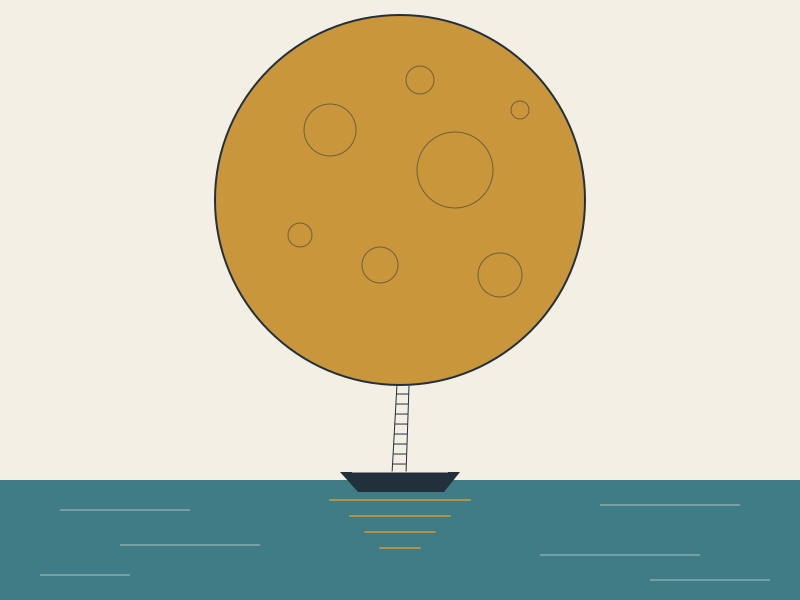
The moon within reach. From the idea of a Cosmicomics story: a moon close enough to climb to. 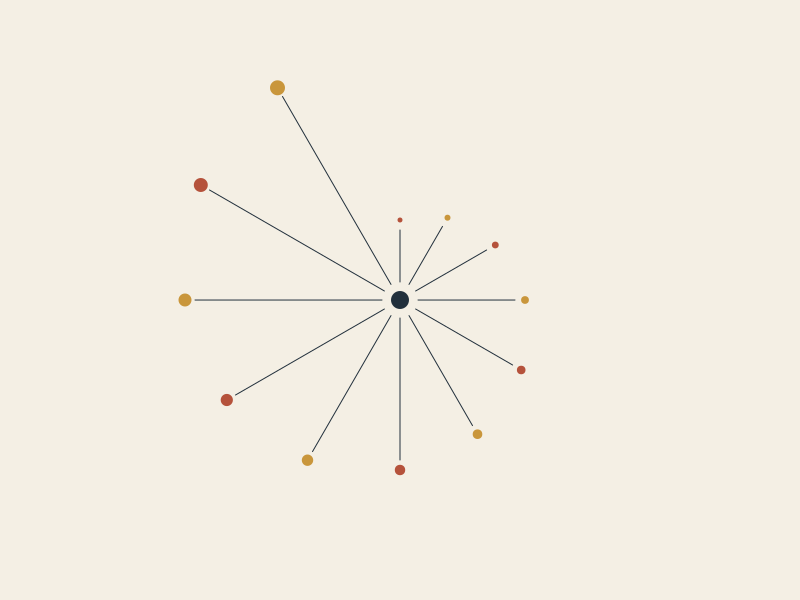
Everything at one point. Everything packed into one point, then spreading. Twelve rays for the twelve stories. 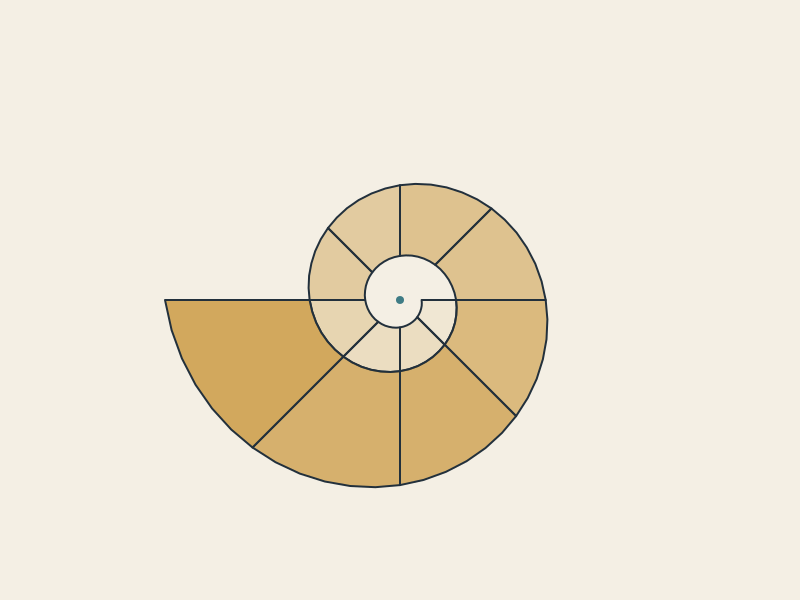
The first shell. A mollusc makes the first shell. Twelve chambers, one for each story. 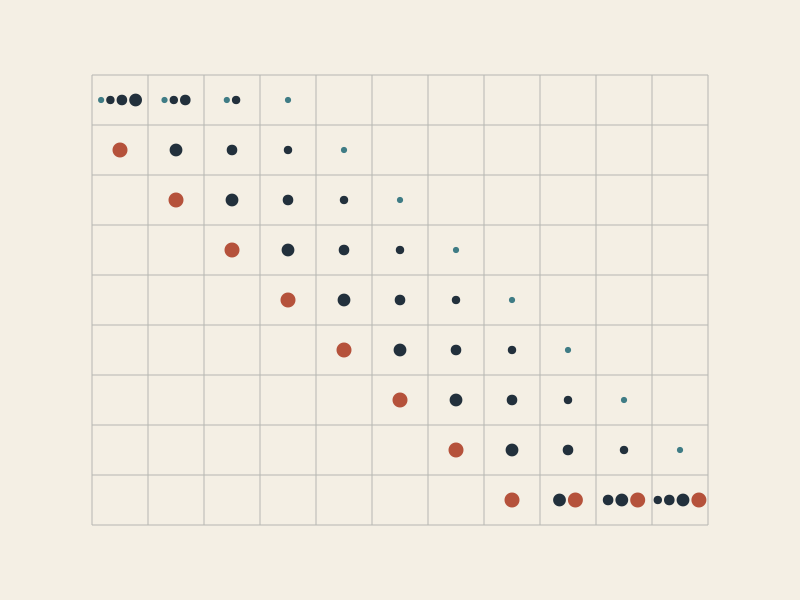
Fifty-five cities, nine chapters. The plan of Invisible Cities: 11 groups of 5 over 9 chapters, 55 marks. Larger dots are later cities in a group. 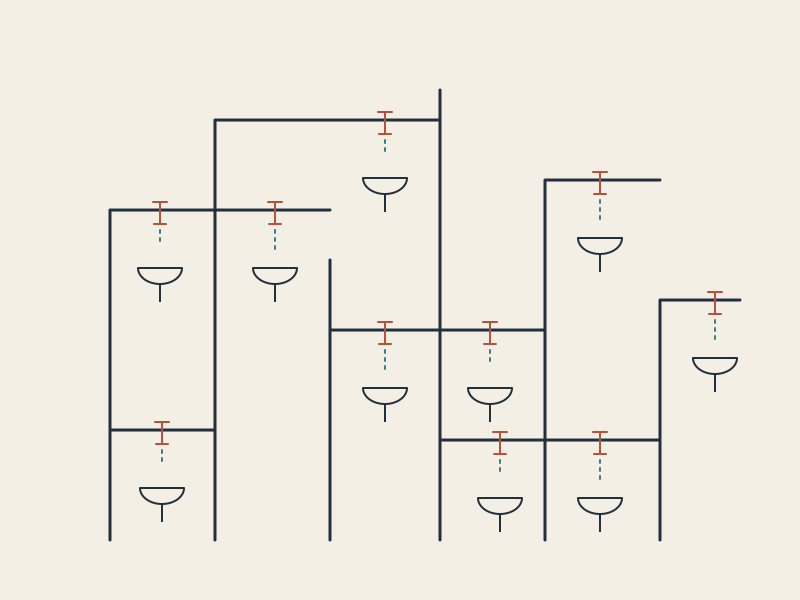
A city of pipes. A city that is only its plumbing, standing in the open. 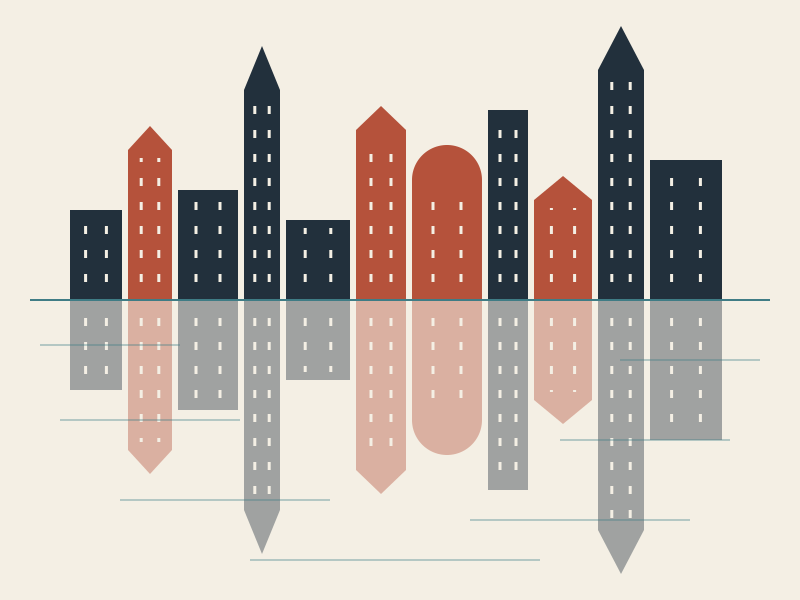
A city and its reflection. A city doubled in a lake. Eleven buildings, one for each group of cities. 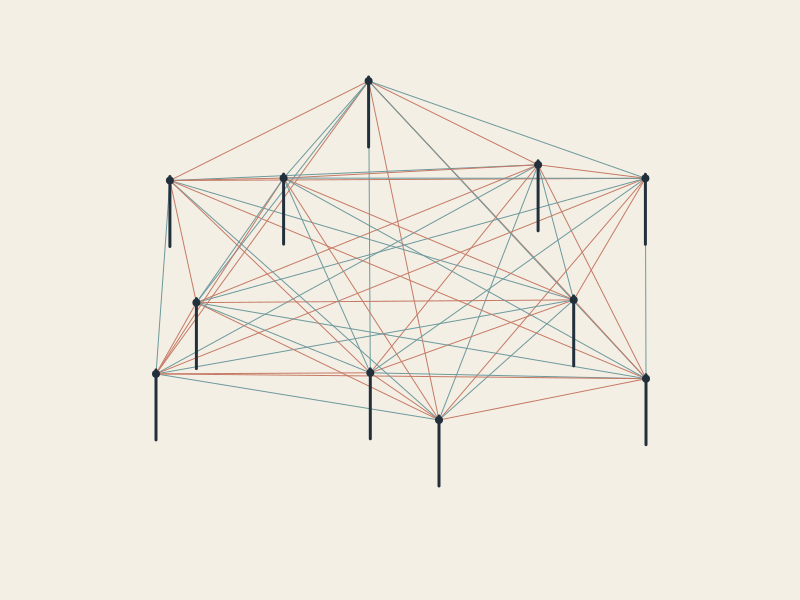
Strings between houses. Strings mark who is tied to whom. Eleven poles, and a string for every pair: 55.
Sources
We opened each of these on 14 November 2026. Where a fact rests on one source only, the line under that part says so. Gambot is not affiliated with Calvino's estate, his translators or his publishers, and none of them made or approved anything here.
- Italo Calvino, Wikipedia Opened. Life dates and places, parents, the war years, the party, Einaudi, book years, Paris and Oulipo, the lectures.
- Italo Calvino, The Art of Fiction No. 130, The Paris Review Opened. How the interview was put together, Updike's remark, Weaver's remembrance, how Calvino worked.
- Plan for a Journal, by Italo Calvino, translated by Ann Goldstein, The Paris Review Opened. The 1970 typescript, the book it comes from, and what the plan proposes.
- Cosmicomics, Wikipedia Opened. Years, translator, award, the narrator and the premises of the stories.
- Invisible Cities, Wikipedia Opened. Years, publisher, the frame, the eleven groups, the chapter counts, the order of chapters 1 and 9, the 1983 remark, the page count, the award nomination and the opera.
- Six Memos for the Next Millennium, Wikipedia Opened. The six qualities and that five lectures were finished.
- Hong Kong architect William Lim and the Italo Calvino novel that changed his life, South China Morning Post Opened. One architect's account of the book among architecture students. A single source.
- Invisible Cities by Italo Calvino, a reader's summary, Scribd Partly seen: one page only, and the writer is not named. Used only for the shape of the ending.