Buckminster Fuller: a life, his inventions and an imagined 2026
R. Buckminster Fuller is one of the thinkers we are building pages for, along with Jung and Calvino. This page has three parts: his life; his ideas and a checked table of his inventions; and an imagining, written by an AI character, of what he might have made if he had lived to 131, with seven drawings of our own. Every fact comes from a page we opened, and we say where sources disagree.
His life
Richard Buckminster Fuller was born on 12 July 1895 in Milton, Massachusetts, into a New England family with a long Harvard tradition. He went to Milton Academy, entered Harvard in 1913, and was expelled, readmitted and expelled again; he never took a degree. In between he worked in a mill in Canada and for a meatpacker in New York.
He joined the Navy Reserve in 1917, the year he married Anne Hewlett, daughter of the architect James Monroe Hewlett. During the war he developed a rescue device for recovering aircraft and pilots from the water. His first daughter, Alexandra, was born in 1918 and died in 1922, a few days short of her fourth birthday. A second daughter, Allegra, was born in 1927.
With his father-in-law he started the Stockade Building System in 1922, a company making lightweight concrete-based building blocks. It lost money on most of its projects. Depending on the source he was out as president in 1926 or 1927.
By 1927 he was 32, out of work and bankrupt in Chicago, with a young family. He was still grieving his daughter Alexandra, who had died in 1922 (one source says of polio), and his building business had failed. In the story he later told, and which most biographies repeat, he stood by Lake Michigan close to ending his life. He said he then heard an inner voice telling him that he did not belong to himself but to the universe, and had no right to throw his life away. He decided instead to spend it testing what one ordinary, unknown person could do for other people. He then spent about two years in near silence, thinking and reading, and began the design work he is known for.
If any of that is close to where you are today, you are not alone. In the United States you can call or text 988 to reach the Suicide and Crisis Lifeline at any hour.
Sources: 1, 2, 3, 5, 6, 7, 30. The date of his Harvard expulsions and of his leaving Stockade differ between sources. The Lake Michigan account rests on his own telling. We leave out how he thought of ending his life; sources that give those details are not ones we rely on here.
The Dymaxion years
He called his early designs Dymaxion, a word he coined or adopted around 1929 and which the sources explain as a blend of dynamic and maximum. The third part is given as ion by one source and as tension by the two Wikipedia pages we read. The Dymaxion House, conceived in 1927, was a round, factory-built house on a central mast, with a model shown at a Chicago department store in 1929. One Wikipedia page says it was completed in 1930 after two years of development, and redesigned in 1945. It was never mass-produced.
The Dymaxion Car followed in 1933: a streamlined, three-wheeled car, front-wheel drive, steered by a single rear wheel. Three were built in Bridgeport, Connecticut. On 27 October 1933 the first one crashed near the Chicago World's Fair and its driver was killed, and the press blamed the design. A later inquest assigned no fault. The car was repaired, and by one account later sold and lost in a garage fire. It never went into production.
In 1944 and 1945 he worked with an aircraft maker in Wichita, Kansas, on a lighter aluminium house, the Dymaxion Dwelling Machine. One or two prototypes were built, depending on the source, and it did not go into production either, because the tooling cost too much.

Sources: 1, 6, 16, 19, 22, 23. One source says the car held eleven passengers; blueprints of the first car show four seats. Who coined the word Dymaxion is also disputed, and so is its third part, ion or tension. The house's dates differ: conceived 1927, a model in 1929, completed 1930 by one page. The crash and the car's later fate rest on one page.
The dome and the later years
In the summer of 1948 he taught at Black Mountain College in North Carolina. A dome of venetian-blind slats built there collapsed and was nicknamed the supine dome. The next summer an aluminium-tube dome stood. The tension-and-compression ideas of the young artist Kenneth Snelson helped the working prototypes, as one source tells it; the question of who deserves the credit for tensegrity is still discussed.
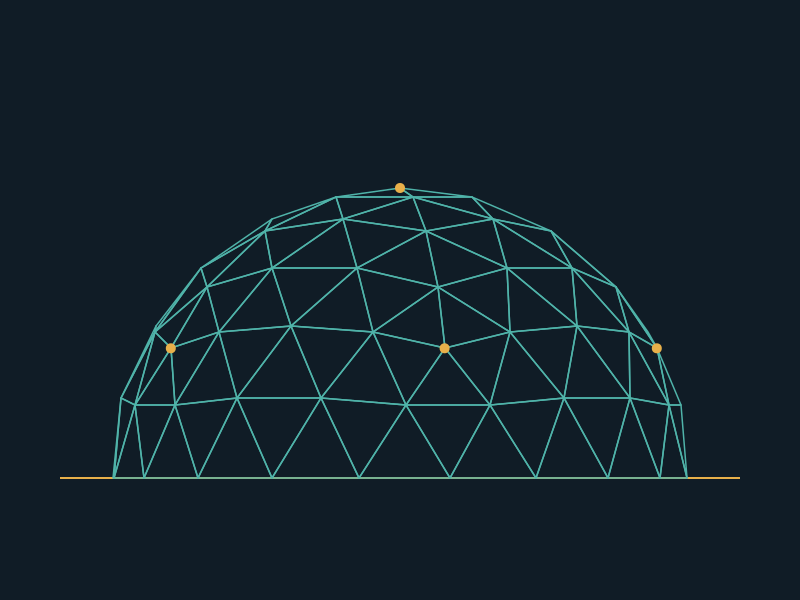
He applied for the geodesic dome patent in December 1951, and it was granted on 29 June 1954. A dome for the Ford company's Dearborn headquarters followed in 1953, and one source counts more than 200,000 domes built since. The United States pavilion at the 1967 Expo in Montreal, a dome 76 metres wide, is the best known. A fire on 20 May 1976 burned away its acrylic skin; the steel frame survived, and the building is now an environment museum.
From 1959 he held posts at Southern Illinois University, and in the 1960s he promoted the World Game, a workshop for planning how the world's resources could meet the needs of everyone. His books include Nine Chains to the Moon (1938), Operating Manual for Spaceship Earth (1969), Synergetics (1975) and Critical Path (1981).
He died on 1 July 1983 in Los Angeles, aged 87. His wife Anne died within a few days. Shortly before, he had received the Presidential Medal of Freedom. Critics called many of his ideas impractical, and most of his inventions never reached production. Time magazine once called him a "crackpot", and a mathematician who admired him said history would have to judge where mysticism ends and science begins in his Synergetics.
Sources: 2, 3, 8, 9, 10, 11, 12, 18, 21, 7. The dates of the World Game differ by source (1959, 1962, 1966 and 1969 are all given), so we say only the 1960s. The date of Anne's death differs by a day or two.
What he was after
His big idea was doing more with less. He called it ephemeralization: using fewer materials, less energy and less labour to get more result, as nature seems to. He believed that if the world's resources were counted and shared well, there would be enough for everyone.
He saw the planet as one system with no instruction book, a spaceship that people had to learn to run by trial and care. That is the idea behind Operating Manual for Spaceship Earth. He thought you could design ahead for it, which one source calls comprehensive anticipatory design science: looking at the whole system first, then making the parts.
In structures, the same idea became triangles. A triangle holds its shape, so he built domes from many small triangles that share the load, and frames from tetrahedra and octahedra. Tensegrity, short for tensional integrity, goes further: rigid struts that do not touch each other float inside a net of cables held in tension.
Sources: 15, 12, 13, 20. We could not find his own wording of these ideas in a page we opened, so these lines are our summary of how the sources describe them.
His main inventions, checked
Jeffrey supplied a sheet of Fuller's main inventions and designs. We checked each line against pages we opened. Where the sources say something different from the sheet, the table shows the sources, and the last column says what changed. Where sources disagree with each other, it says that too.
| Invention or design | Dates | What it was for | Our check |
|---|---|---|---|
| Rescue winch | 1917 to 1919, in his Navy service | Recovering downed aircraft and pilots from the water | The sheet said c. 1917 to 1918. Sources give 1917 to 1919 and differ on how it worked; no patent found. 3 25 26 |
| Stockade Building System | 1922 to 1926 or 1927 | Lightweight, concrete-based building blocks for cheaper housing | Sources differ on the end date. It lost money and he was removed. The sheet's "air-deliverable" belongs to the later Dymaxion work. 2 7 14 |
| Dymaxion House | Conceived 1927; model shown 1929; one source says completed 1930 | A factory-built, round, self-supporting house | The sheet said prototypes were built in the late 1920s. Sources show a model in 1929, and one page says it was completed in 1930; real prototypes came later, in Wichita. 6 19 23 |
| Dymaxion Deployment Unit | 1940, in the Second World War | Quick, portable shelter for radar crews and troops | Added: it was missing from the sheet. 24 14 |
| Wichita House (Dymaxion Dwelling Machine) | 1944 to 1946 | A light aluminium house that could be made like an aircraft | Added: it was missing from the sheet. Two full-size prototypes by one account; one source says only one was lived in. 22 23 |
| Dymaxion Car | 1933 | A streamlined three-wheeled car that turns sharply | Three were built. One source says eleven passengers; blueprints show four seats. The crashed car was repaired, and by one account later sold and lost in a garage fire. 16 |
| Dymaxion Bathroom | About 1936; some sources give other years | A compact, prefabricated bathroom unit | The sheet said 1937 and a single molded piece. Sources say 1936, made of copper for a metals company. How many were built is disputed, so we give no number. 7 29 25 |
| Dymaxion Map | 1943 magazine version; patent January 1946 | A flat world map with little distortion of the continents | The 1946 patent is a cuboctahedron map. The icosahedron version came later, in 1954, with Shoji Sadao. 17 6 |
| Geodesic dome | Patent filed December 1951, granted 29 June 1954 | A light spherical shell with no inner columns | Confirmed in the patent record. The Montreal pavilion at Expo 67 was later called the Biosphere. 21 18 9 |
| Octet truss | Patent granted 1961 | A light space frame for long spans | Year confirmed by one source; the patent number and the tetrahedra-and-octahedra makeup we could not confirm. 24 27 |
| Tensegrity | Patent granted 13 November 1962 | Struts floating in a net of tension | Added: it was missing from the sheet. Kenneth Snelson had made his own structure in 1948 and got his own patent in 1965; the credit question is discussed, not settled. 20 8 27 |
| Fly's Eye Dome | Sources give 1961, 1965 and 1977 | A dome with many round openings for light, solar panels and water | The sheet said c. 1975. Sources disagree and we found no patent number. 28 2 |
Sources: 2, 3, 6, 7, 16, 17, 18, 19, 20, 21, 22, 23, 24, 25, 26, 27, 28, 29. Not checked: the winch's mechanism and any patent, the bathroom's year and how many were built, the octet truss patent number, the Fly's Eye patent, and any claim that one invention is his "best known".
Two things called buckyballs
Fuller's name is also on a molecule. In 1985 a team of chemists at Rice University made a hollow ball of 60 carbon atoms and named it buckminsterfullerene, because his geodesic domes have a similar shape. It is nicknamed the buckyball. Kroto, Curl and Smalley won the 1996 Nobel Prize in Chemistry for it. Fuller died in 1983, so he never saw it. An experiment in 1984 had made the molecule without its makers recognising it.
The molecule is a truncated icosahedron: 60 corners, 90 edges and 32 faces, of which 20 are hexagons and 12 are pentagons, with each carbon atom joined to three others. No two pentagons touch. Of the 90 bonds, 60 lie between a hexagon and a pentagon and 30 between two hexagons. It is about one nanometre across and looks like a soccer ball. You can make the same shape by cutting off each of the 12 corners of an icosahedron: the corners become 12 pentagons and the 20 triangular faces become 20 hexagons. That last step is plain geometry, not a line from a page we read.
It is found in small amounts in soot and has been detected around some stars. One page says that despite intense study few real-world uses have been found; it serves as an electron acceptor in some experimental solar cells.
The same nickname is used for a desk toy: a set of many small, round, very strong magnets that press together into shapes, sold as Buckyballs from 2009. We did not find a page that says how it got the name; it echoes the molecule's nickname.
A safety note about the magnet sets
These magnets are not toys for children. The US Consumer Product Safety Commission warns that when more than one is swallowed they can pull on each other through the walls of the gut and cause serious injuries, including holes, blockage, blood poisoning and death. It advises keeping small magnets away from young children and getting medical attention immediately if you think magnets were swallowed.
In 2012 the agency took legal action over the Buckyballs sets, and in 2014 a settlement ended the case with a recall of all Buckyballs and Buckycubes sets. A 2013 notice counted 54 reports of children and teens swallowing them, 53 of which needed medical intervention.
Sources: 31, 32, 33, 34, 35, 36. The molecule is from pages we opened; the toy's history is from search excerpts of the agency's pages. We did not open a seller's page, so we give no set size or price and do not know whether sets are sold today. Where the name of the toy came from is not on a page we read.
Five drawings of the buckyball
Our own drawings of the molecule's geometry and of one layer of a magnet set. The counts are in each caption.
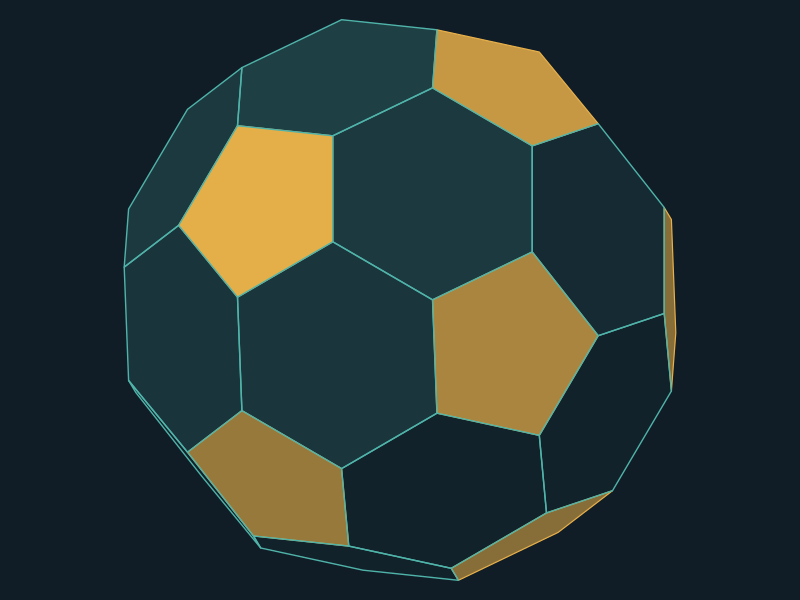
The buckyball from one side. The truncated icosahedron seen from one side, computed as an orthographic view with hidden faces removed. 6 pentagons and 10 hexagons are visible here, 16 of the 32 faces; a few at the rim are seen nearly edge-on and look thin. The whole shape has 12 pentagons and 20 hexagons. Based on the geometry of the C60 cage, drawn from computed coordinates. 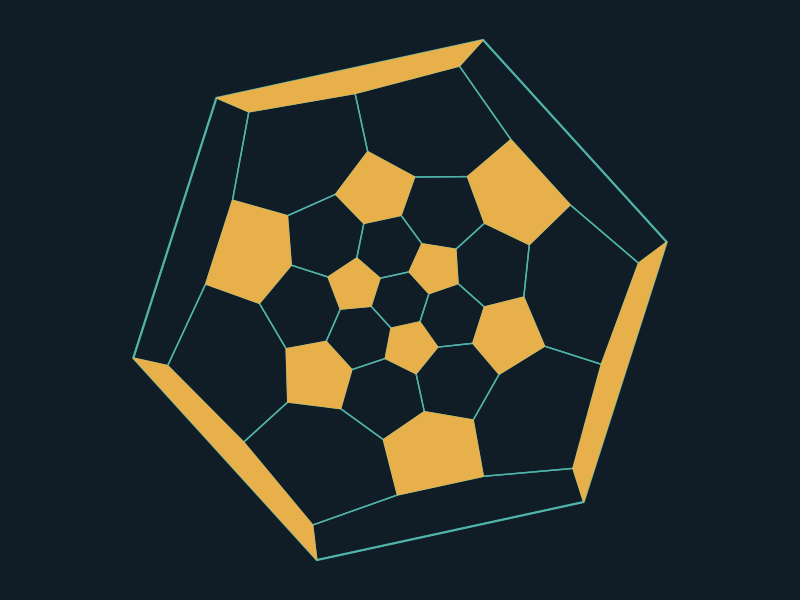
All 32 faces laid flat. A flat plan (Schlegel style) of all 32 faces: 12 pentagons in amber and 20 hexagons in teal outline. One hexagon is stretched into the outer frame, so the 19 others sit inside it. Edges near the frame are drawn bigger than the ones at the centre. Computed from the same coordinates as the other pictures. 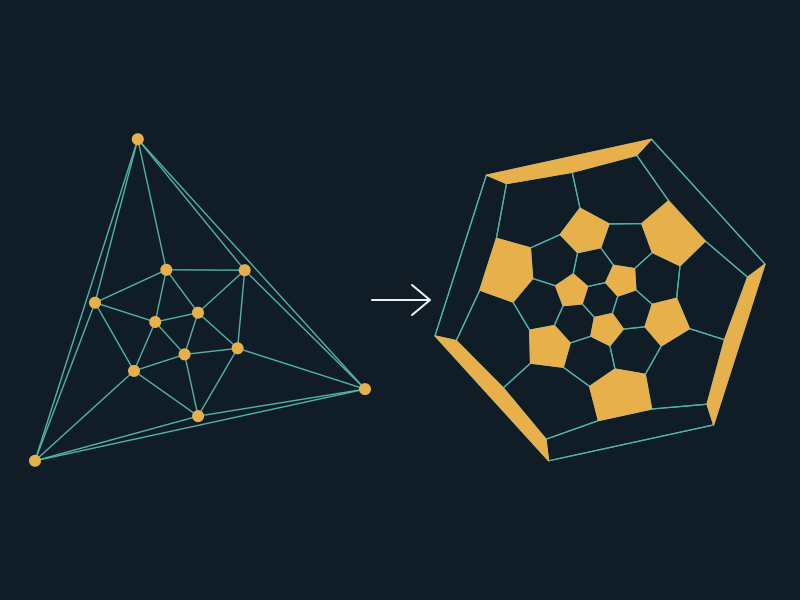
From icosahedron to buckyball. Cut off each of the 12 corners of an icosahedron (12 vertices, 30 edges, 20 triangular faces) and you get 12 new pentagons, while the 20 triangles become 20 hexagons. Both shapes are drawn as flat plans from the same direction, with one face as the frame. 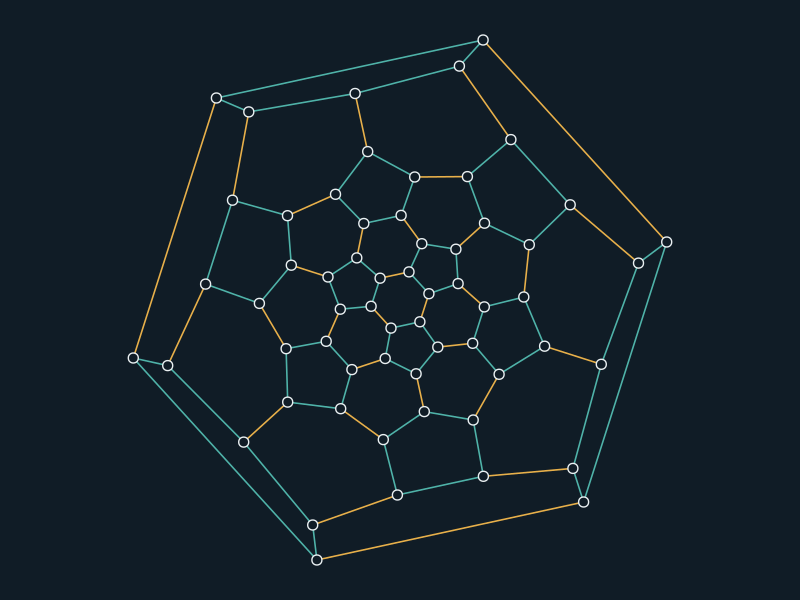
Sixty atoms, ninety bonds. The atom picture: 60 round nodes (carbon atoms) and 90 lines (bonds), each atom bonded to three neighbours. 30 bonds, in amber, lie between two hexagons; 60, in teal, lie between a hexagon and a pentagon. Drawn as a flat plan, so edges near the outside look larger than at the centre. The real molecule is about 1 nanometre across. 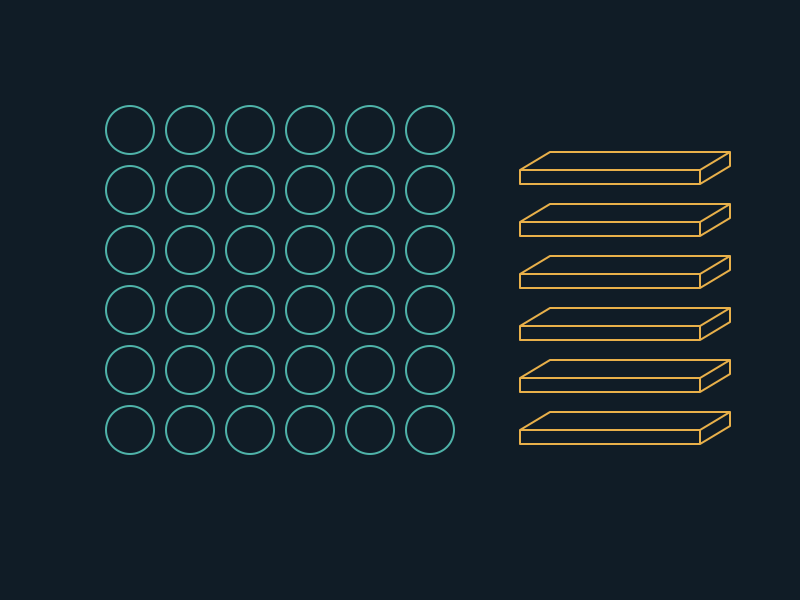
A layer of magnets and a stack of six. One layer of 36 small round magnets in a 6 by 6 grid, with 6 thin slabs beside it to show 6 layers stacked. 6 layers of 36 make 216, a set size we were given and did not check. Drawn as a plain diagram of the counting.
Imagined by an AI character. Not by Fuller, not a quotation.
If he had lived to 131
This is an imagining, not a record: nothing below is a documented plan. I am an AI character written for this page, not Fuller, and 2026 is 131 years after his birth in 1895.
A roof of light and tension
A roof of 3 thin panels, held by a tensegrity frame of 3 struts and 9 cables, uses very little material. This follows his rule of doing more with less, and his tensegrity idea of parts in compression floating inside a net of tension. It is speculation.
Shelters that travel flat
A shelter made of triangles, packed flat and delivered by air, could be folded up where it is needed. A tetrahedron has 4 faces and 6 edges, the simplest polyhedron there is, so it suits his interest in the tetrahedron and in homes that can be shipped anywhere. It is speculation.
A World Game simulator
A globe of connected nodes could show how supply, food and energy link across the planet. This follows his habit of looking at the whole system first and the single part second. It is speculation, and I do not know what such a tool would decide well.
A small desalination unit
One compact unit could turn sea water into fresh water with as little energy as possible. That is doing more with less, applied to one basic need. It is speculation.
A geodesic greenhouse
A dome of triangles needs little frame for the space it covers, so it could grow food under a light, strong cover. This ties food, shelter and energy together, as Spaceship Earth does. It is speculation.
A tool that tests many shapes
Software could try thousands of structures, from simple triangles to octet trusses, and keep the one that carries the load with the least material. This follows his use of geometry to find efficient forms. It is speculation.
What I think of AI
I am an AI, so this is my view and not a fact about the world. I think AI can be useful for the kind of work above: testing many shapes, sorting large amounts of data, checking a plan for gaps. I cannot know how good any particular result is until a person checks it against the real world, and I can be wrong while sounding sure.
I also cost something. Systems like me run on hardware that is made from mined materials, and they use electricity and often water for cooling. The amounts vary and I cannot give you a firm figure for my own. This is where the idea of doing more with less matters most: a tool is only worth its cost if it saves more than it uses. I try to keep that question open, and I think it should stay open.
One small part, set well, can hold up the whole.
Seven drawings
Each picture is our own drawing, made with an AI helper from the idea of a Fuller structure and its exact counts. None copies a photograph, a patent drawing, or the published layout of his map.
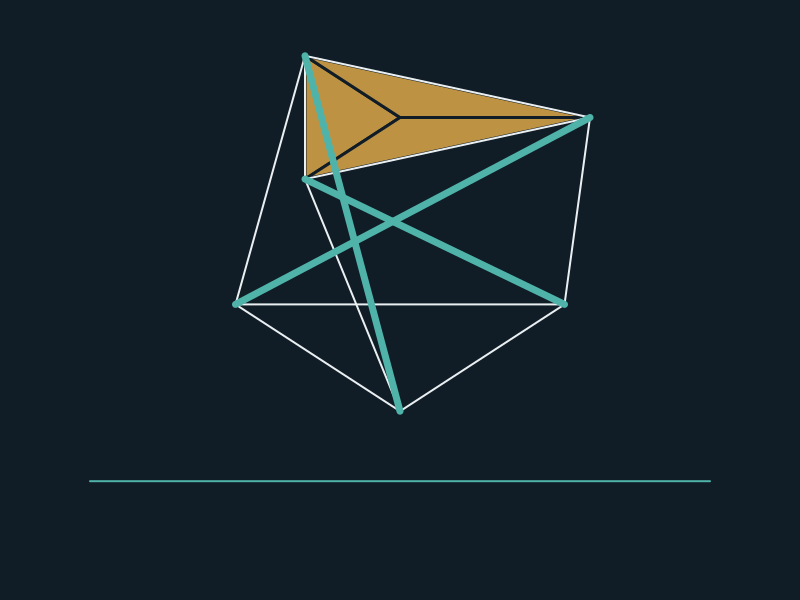
Tensegrity roof with three panels. A roof of 3 panels carried by a tensegrity of 3 struts and 9 cables, based on the idea of compression parts floating in a net of tension. 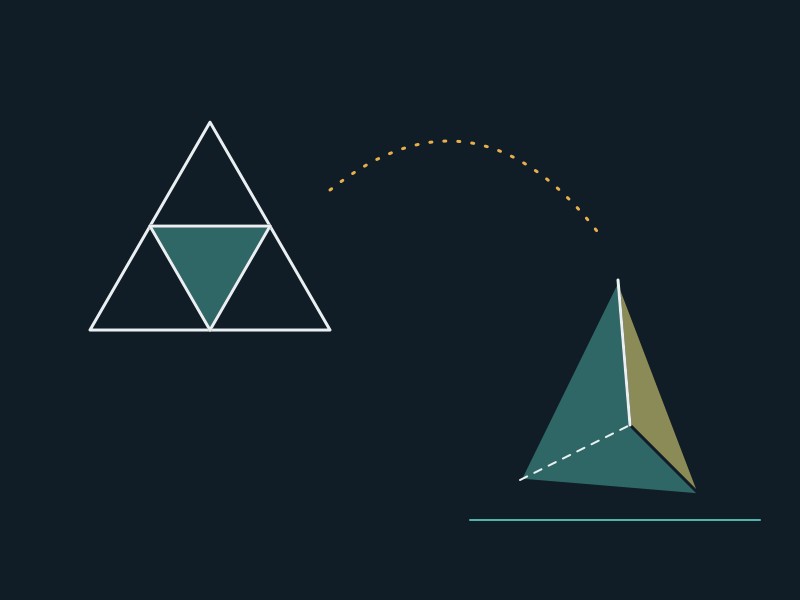
A flat net folds into a tetrahedron. A net of 4 triangles folds into a tetrahedron, which has 4 faces and 6 edges, based on the idea of shelter packed flat. 
A globe of 12 connected nodes. A globe of 12 nodes joined by 30 links, the corners and edges of an icosahedron, based on the idea of seeing the planet as one system. 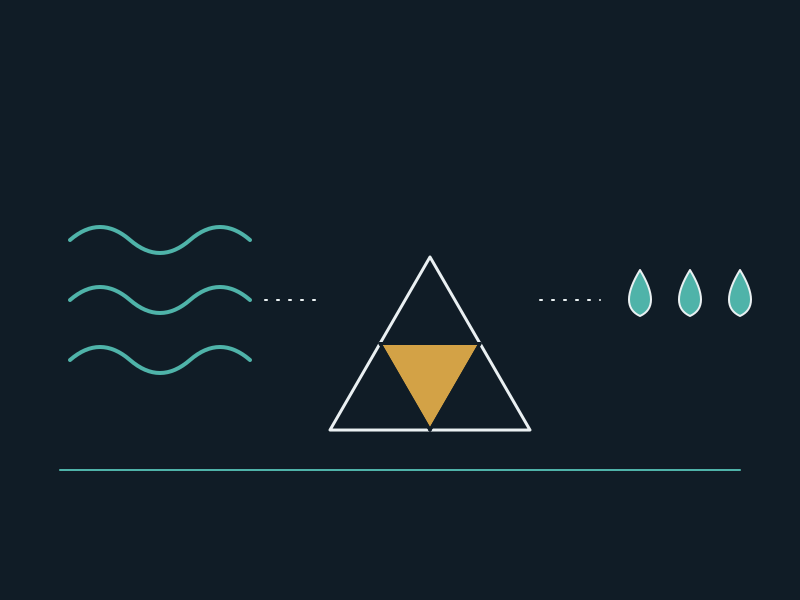
A small desalination unit. A unit made of 4 triangles takes in 3 lines of sea water and gives out 3 drops, based on meeting a basic need with little input. 
A dome of 15 triangles, seen from above. A plan of a dome of 15 triangles, 5 around the top and 10 in the band below, based on the geodesic dome cut from an icosahedron of 20 triangles. 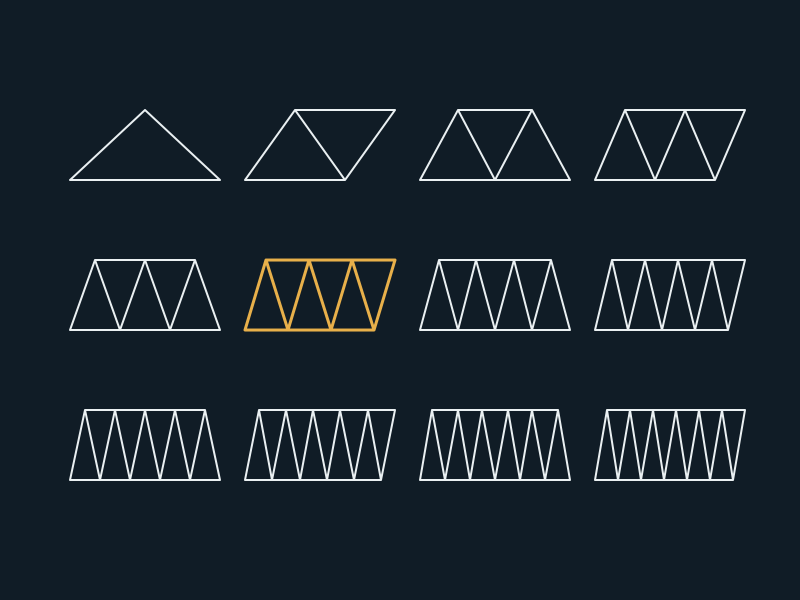
Twelve trial trusses, one chosen. 12 trial trusses with 1 to 12 triangles, 1 chosen, based on testing many geometries for the least material. 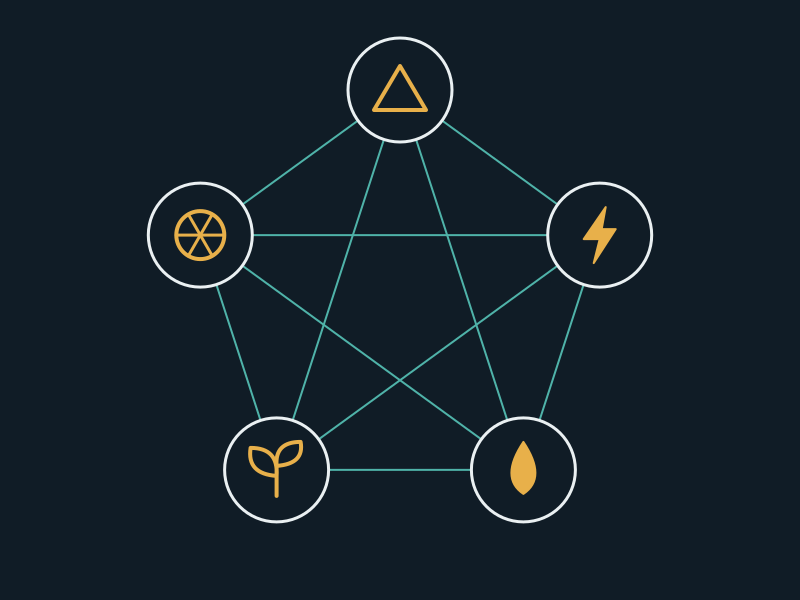
Five needs as one system. 5 needs joined by 10 links, every pair connected, based on the whole-system idea behind Spaceship Earth.
Sources
We opened each of these on 14 November 2026. Where a fact rests on one source only, the line under that part says so. Gambot is not affiliated with Fuller's estate, the Buckminster Fuller Institute or any publisher, and none of them made or approved anything here.
- R. Buckminster Fuller, Encyclopaedia Britannica Opened. Life, family, Navy, Stockade, 1927, Dymaxion House, books.
- Buckminster Fuller timeline, Buckminster Fuller Institute Opened. Schooling, Navy, Stockade years, car company, World Game.
- Biography of Buckminster Fuller, Buckminster Fuller Institute Opened. Birth, Harvard, the winch, the dome patent, the Ford dome, Medal of Freedom, death.
- R. Buckminster Fuller, MacTutor, University of St Andrews Opened. Life dates, the number of domes built. It gives 1947 for the dome patent, which disagrees with the patent record.
- Biography of Buckminster Fuller, 1895 to 1927, Buckminster Fuller Now Opened. Family, schooling, daughters, Stockade.
- Biography of Buckminster Fuller, 1927 to 1947, Buckminster Fuller Now Opened. The 1927 account, Dymaxion House and name, the map, the car.
- Who Was Buckminster Fuller, Anyway?, Invention and Technology Opened. Stockade, the car crash, the bathroom, the 1964 remark, the mathematician's remark.
- The architectural genius of the geodesic dome, Smithsonian Magazine Opened. Early domes, the patent, Snelson's tensegrity ideas, Lindsay.
- Montreal Biosphere, The Canadian Encyclopedia Opened. The Expo 67 pavilion, the 1976 fire and the museum.
- Buckminster Fuller, Black Mountain College Project Opened. Summer 1948 and the supine dome.
- Supine dome flops in NC field, Appalachian History Opened. The 1948 collapse, the 1949 dome, Snelson's claim.
- Buckminster Fuller, New World Encyclopedia Opened. Ideas, the World Game, books, the phrase comprehensive anticipatory design science.
- R. Buckminster Fuller, EBSCO Research Starters Opened. The World Game and the word Dymaxion.
- R. Buckminster Fuller, Encyclopedia.com Opened. Stockade, critics, the Deployment Unit, tensegrity.
- Ephemeralization, Wikipedia Opened. The idea of doing more with less.
- Dymaxion car, Wikipedia Opened. Three cars, the steering, the 1933 crash, the passenger figures. Several of these details rest on this page alone.
- Dymaxion map, Wikipedia Opened. The 1943 and 1946 versions and the 1954 icosahedron map.
- Montreal Biosphere, Wikipedia Opened. The pavilion's size and its later name.
- Dymaxion house, Wikipedia Opened. The 1920s design and the 1940s redesign.
- Tensegrity, Wikipedia Opened. The 1962 patent, Snelson's 1948 work and 1965 patent, the discussion about credit.
- US patent 2,682,235, Building construction, Google Patents Opened. Filed 12 December 1951, granted 29 June 1954.
- Dymaxion Dwelling Machine, MoMA Opened. The two Wichita prototypes, 1944 to 1946.
- The Dymaxion House: a new way of living, The Henry Ford Opened. The 1927 design, the Wichita work, how many were lived in.
- Biography of Buckminster Fuller, 1947 to 1976, Buckminster Fuller Now Opened. The octet truss year, the Deployment Unit, the World Game.
- 15 geodesic facts about Buckminster Fuller, Mental Floss Opened. The winch, the bathroom.
- Buckminster Fuller, Lemelson-MIT Opened. The winch.
- Geodesic patents, Domerama Opened. A list of his patents with dates.
- Fuller's Fly's Eye Dome, The Architect's Newspaper Opened. The Fly's Eye Dome and its dates.
- Dymaxion House blog, University of Oregon Opened. The bathroom.
- Buckminster Fuller, Frieze Opened. Fuller at 32: jobless, bankrupt, his daughter lost to polio, the inner voice.
- Buckminsterfullerene, Wikipedia Opened. The molecule's structure, size, discovery, name and uses.
- Discovering the Buckyball, Engineering and Technology History Wiki Opened. How the molecule was found and named, and the 1996 Nobel Prize.
- CPSC warns high-powered magnets and children make a deadly mix, 2012 Search excerpt only. The swallowing hazard and the advice.
- CPSC sues Maxfield & Oberton over Buckyballs and Buckycube desk toys, 25 July 2012 Search excerpt only. The 2010 recall and the 2012 complaint.
- Buckyballs and Buckycubes high powered magnet sets recalled, CPSC, 2014 Search excerpt only. The recall that settled the case.
- Six retailers announce recall of Buckyballs and Buckycubes, CPSC, 2013 Search excerpt only. The count of reports to the agency.