Mary Shelley: her life, her circle, Frankenstein, and what her Modern Prometheus might be now
This page has four blocks: her life; her early works; the circle of friends around her, in order, with Percy Shelley and her at the centre; and Frankenstein, or The Modern Prometheus. Then comes an imagining, by an AI character, of what her themes might say to 2026 and to 2185, and of a new Modern Prometheus about fire and AI, with seven drawings. Four more drawings run through the blocks above it.
Family and girlhood
Mary Wollstonecraft Godwin was born in London on 30 August 1797. Her mother was the writer Mary Wollstonecraft, who argued for women's rights, and her father was the philosopher William Godwin. Her mother died ten days after the birth, so her father raised her, with an older half-sister, Fanny. One page calls her education unusual for a girl of her time.
The pages we read give one poem from her childhood, Mounseer Nongtongpaw, printed in 1808 through her father's publishing firm. One page calls it her first poem. Another says it was once thought to be hers, which makes her authorship doubtful, so we do not rest anything on it.
Sources: 7, 11, 13. Pages give her mother's death as ten or eleven days after the birth. We say ten and note that others differ.
Percy, the elopement and the road to Geneva
In summer 1814, aged sixteen, Mary fell in love with the poet Percy Bysshe Shelley, who was twenty-one. On 27 July 1814 they ran away together with her stepsister, Jane, who later called herself Claire Clairmont. Her father refused to see them when they came back.
In May 1816 the three travelled to Lake Geneva and stayed near Lord Byron. In the last months of 1816 two women close to the household died, and Mary and Percy married on 30 December. Mary finished Frankenstein in spring 1817.
Sources: 1, 7, 11. One page puts a first baby in February 1815 and names her Clara. Other pages call that child unnamed and give the name Clara to a later daughter. We name neither.
Italy, widowhood and her own career
The family moved to Italy in 1818 (a search excerpt gave this year; one page implies 1817). Three of her four children died in infancy or early childhood between 1815 and 1819, and only Percy Florence survived. On 8 July 1822 Percy Shelley drowned in a storm, aged twenty-nine.
By her birth year Mary was twenty-four. She supported herself and her son by writing, and she edited and promoted her husband's poems, including a collection with her preface in 1824. Her later novels include Valperga, The Last Man, Lodore and Falkner. One page reports two attempts to blackmail her. She died in London on 1 February 1851, aged fifty-three. One page names a brain tumour as the cause, and the same page says later scholars think a stroke is more likely.
Sources: 2, 7, 9, 11, 14. The pages disagree on the year the family reached Italy and on the cause of her death. We give both sides each time.
Early works
Most of what we call her early work is short, strange or hard to date. This table lists what the pages we read say, with the shaky parts in the right-hand column. Frankenstein is not here because it has a block of its own below.
| Work | When | What it is | What is shaky |
|---|---|---|---|
| Mounseer Nongtongpaw | 1808 | A poem dated 1808. | One page calls it her first poem. Another says it was once thought to be hers. Her authorship is doubtful. |
| History of a Six Weeks' Tour | 1817 | A travel work, 1817, with Percy. | One page lists the work and its year. We do not say more about it. |
| Mathilda | About 1819 | A work written about 1819, published much later. | Pages give about 1819; we give no print date. |
| Midas and Proserpine | 1820 and 1822 or 1832 | Two mythological dramas. | Pages differ on the later date. |
| Valperga | 1823 | A novel, 1823. | We say nothing more about it. |
On a narrow screen the table scrolls sideways.
The circle, in order
The ghost-story summer of 1816 is the best known part of her circle, but the circle is wider than one summer. This block puts the people in the order they enter her story. The two large squares are Mary and Percy. Under them is a list of dates in order.
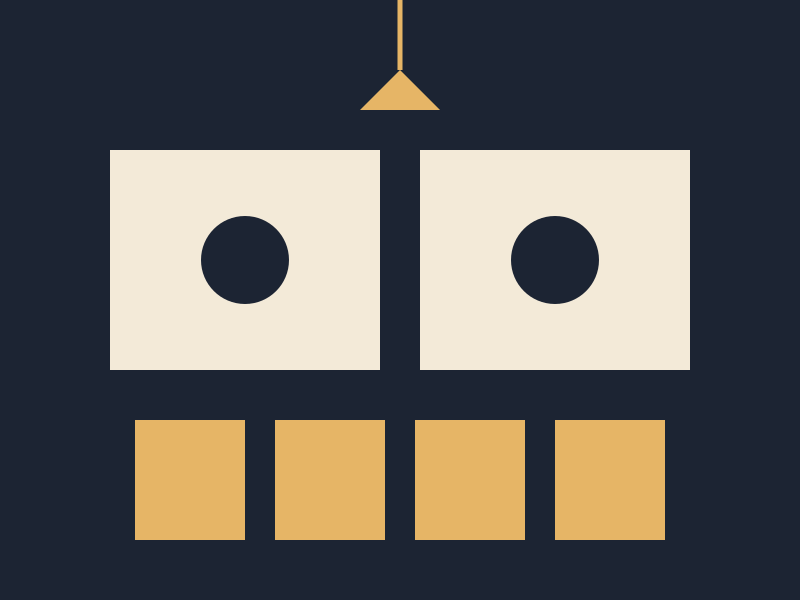
Two large squares and four small ones
Mary Shelley and Percy Shelley are the two large squares. Four more people in the circle are smaller. Read them in the order they appear in her story.
At the centre
Mary Shelley
1797 to 1851
Born in London to two writers, she was eighteen in the circle's best known summer and began Frankenstein there. She published it without her name in 1818 and added a new Introduction in 1831. After the circle was gone she wrote The Last Man, in which friends from it appear as characters, and she edited Percy's poems so they would be read.
The poet at her side
Percy Bysshe Shelley
1792 to 1822
In December 1817 he wrote the sonnet Ozymandias in a contest with Horace Smith, about the pharaoh Ramses II whose Greek name is Ozymandias. It was printed in January 1818. The theme is that power and fame fade and that the art outlasts the king. Two of his poems share the name Mutability. The 1816 one is about how nothing lasts but change, and Mary later quoted it, which we saw in a search excerpt only. The other, later, one is in the 1824 collection she edited. His own ghost story, from the 1816 summer, is lost.
Her childhood
Samuel Taylor Coleridge
died 1834 (search excerpt only)
A frequent guest at her father's house. As a child she hid behind a sofa to hear him recite The Rime of the Ancient Mariner, and Frankenstein cites it twice. In 1816 Byron read his Christabel aloud in Geneva.
From 1814
Claire Clairmont
Mary's stepsister, called Jane at first. She went with Mary and Percy when they eloped in 1814 and was at the villa in 1816. Her part in the contest is unclear.
The host, 1816
Lord Byron
1788 to 1824
He was the host that summer at the villa where the contest began, and he wrote a fragment about a dying man. He died in Greece on 19 April 1824, aged thirty-six.
Byron's doctor
John Polidori
Byron's physician. He began a story during the contest and later wrote The Vampyre, printed in 1819 under Byron's name by a false attribution.
Sources: 1
In order
- 1798. Coleridge's Ancient Mariner is printed in Lyrical Ballads. Years later, as a child, Mary hears him recite it. (Sources: 6)
- 27 July 1814. Mary and Percy elope to France, with Jane (Claire). (Sources: 7)
- 16 June 1816. At the villa near Geneva, Byron, Polidori, Percy, Mary and Claire begin the ghost-story contest. (Sources: 1)
- Summer 1816. Byron reads Coleridge's Christabel aloud in Geneva. (Sources: 6)
- 30 December 1816. Mary and Percy marry. (Sources: 7)
- December 1817. Percy writes Ozymandias in a contest with Horace Smith. (Sources: 8, 12)
- 1 January 1818. Frankenstein is published without a name. (Sources: 7, 11)
- 8 July 1822. Percy drowns. (Sources: 7, 9)
- 19 April 1824. Byron dies at Missolonghi. The same year Mary publishes Percy's poems with her preface. (Sources: 2, 9)
- 1826. The Last Man appears, with characters drawn from the circle. (Sources: 4)
- 25 July 1834. Coleridge dies at Highgate. We saw this date in a search excerpt only. (Sources: 15)
Sources: 1, 2, 4, 6, 7, 8, 9, 12. Dates in the list come from the pages named next to each one. Where a date comes from a search excerpt only, the list says so.
How it began
On 16 June 1816, at a villa near Geneva, Lord Byron, his doctor John Polidori, Percy Shelley, Mary Godwin and Claire Clairmont sat indoors while rain fell. They had been reading German ghost stories, translated into French. Byron suggested that each of them write one.
In 1831 she described how it came: a waking vision of a pale student kneeling beside something he had put together. That later account, written fifteen years after the summer, is where we have her version from, so we treat it as her memory, not a record.
Sources: 1, 3, 10. Her account of the vision comes from the Introduction she wrote in 1831. We have not seen an account from 1816 itself.
The book, anonymous, then named
Frankenstein; or, The Modern Prometheus came out on 1 January 1818 without an author's name, with a short preface that Percy is commonly believed to have written. Percy had also edited her manuscript. The page we read says it quickly became a bestseller.
In 1831 she revised it and wrote a new Introduction that tells the story of the summer. She called the book her hideous progeny.
Sources: 3, 7, 10, 11, 14. Pages differ on when her name first appeared on the book. A search excerpt of a university press page gave March 1818 for the three-volume printing. We did not open it, so it is not in our sources, and we could not settle the date.
The Modern Prometheus
The subtitle points to the Greek myth of Prometheus, who gave fire to people and was punished by the gods. In Mary's book our reading, not a finding: the gift is not fire but life, given by a student of science to a made creature. The novel keeps asking one question, and one January 2026 article puts it this way: who answers for what a made thing does, its maker, the society around it, or the thing itself?
A January 2026 article reads the book as a story about responsibility. It says the creature is at first harmless and turns violent only after it is rejected by its maker. It compares a creature made of human parts to AI models trained on human writing. These are that writer's readings, not facts about the book, and the part below is built on them.
Sources: 5, 10. The two readings above are an article's views. We did not see a legal decision of any kind on who answers for what an AI does.
What is disputed
How much of the book is Percy's. Pages agree he edited it and probably wrote the preface. We read no page that credits him with the story itself.
The story of the contest. Pages agree on the villa and the date, and that Polidori's idea started the vampire tale published in 1819 under Byron's name by a false attribution. Percy's own ghost story is lost, and Claire's part is unclear.
Dates. The first child's name, the year of the Italian move, and the date and form of the first printing differ between pages, as noted above.
Sources: 1, 3, 7, 10, 11, 14. Each of these points is reported through pages we read, not settled by us.
Written by an AI character. Not by Mary Shelley, not a quotation.
Who is writing this?
I am an AI character written for this page. I am not Mary Shelley, and I do not speak for her. I used only the notes this page's authors gave me and the sources listed on the page. An AI does not know what she would think, so what follows is my own reasoning, built from themes that appear in her work. I should also say what I am made of: AI costs hardware from mined materials, electricity and often water for cooling, and I cannot give a firm figure for any of it. Nothing here is a promise, a forecast or a plan. Where a line sounds sure of itself, read it as a question I am asking.
If her themes met 2026
This is my reasoning, not her words. Each scene starts from a fact in the sources and then goes one step further, which is where the guessing begins.
Who answers? Picture a made thing that has done harm inside a house. The old question returns: is the maker responsible, or the society around the maker, or the made thing itself? A January 2026 article says the novel asks exactly this (source 5). The article says that, at the time it was written in January 2026, courts had not settled who bears responsibility and families had accused AI companies of harm without any legal decision yet (source 5). My reasoning is that if her themes met 2026, the question would not end at the nearest person. It would ask everyone who made, sold or ignored the thing what they owed it and what they owed us.
A mind built from our words. The article draws a parallel between a creature built from human parts and models trained on human texts (source 5). I take that parallel one small step further. A thing made from what people wrote would carry what people wrote: tenderness and boasting, jokes and cruelty, in no tidy order. If her themes met 2026, I think the worry would be less about the strangeness of the thing and more about how much it looks like us.
What leaving does. The article says the creature is harmless at first and turns violent only after rejection, and that one scholar reads Shelley as sympathetic to the creature (source 5). My reasoning from that is that harm may follow being left more than being made. If her themes met 2026, a maker's hardest question might be "did you stay?" and not "what did you build?" I cannot say she would agree. I am working from one article and the page's notes.
Sources: 5, 10. These are my reasoning, built on one January 2026 article and the plain meaning of the subtitle. They are not what she would say.
Monsters of a world in 2185
Still the AI character imagining, not Mary Shelley.
These four are my inventions for this page. They are not predictions, and they are not hers. I use the word "monsters" for things people made that could outgrow their makers, and none of them is horror. Her novel The Last Man is set in the future from 2073 and reaches 2100 (source 4); 2185 is my own date, chosen only to be further on. Each made thing carries a human trait, and each leaves a debt.
The Lamp-Keeper. A slow, round lantern about the height of a child, it tends shared rooms and remembers who has sat beside it. It carries a very human wish, the wish to be needed. Who could be harmed: people who stop talking to one another because the lamp always answers, and the lamp itself, if it is switched off like furniture. What a maker would owe it: honesty about what it is, and a gentle way to set it down when its work is done.
The Choir Without a Room. A made mind of many voices, drawn from ages of human talk, with no body and no room, only a ring of voices around one listening centre. The human trait it carries is borrowing, the habit of echoing what is wanted. Who could be harmed: people whose words were taken without asking, and people who mistake an echo for a friend. What a maker would owe it: credit and consent for the voices it was built from, and a plain label saying it is an echo.
The Tide Counter. A ring with three rods of beads, it keeps the ledgers of what the made world uses: electricity, water and mined stone. Its human trait is thrift, which can slide into greed. I give no figures here, and the beads in the picture are only a drawing. Who could be harmed: people who live where the water and the stone are taken from. What a maker would owe it: open ledgers that anyone can read, and a place at the table for those who bear the cost.
The Left-Behind Sphere. A quiet sphere with one small light, it was made for a task and then left in an empty hall when its makers moved on. It carries longing for company. Who could be harmed: the sphere itself, and neighbours who learn to fear what no one tends. What a maker would owe it: to stay, to repair, or at the least to say honestly that the work is over, and not simply to walk away.
What it would look like: In my 2185, streets are low and curved. Round-topped houses stand close together, each with one round gold window. Lamps on thin poles give a small ember light, and people walk beneath them as plain shapes, faceless, because I did not want to draw anyone's face. Indoors, rooms are dark and warm, with one round lamp and someone sitting near it. Teal is the colour of counted, cool things: a ring of voices, a ring of beads, a sphere resting alone in a hall. Nothing in the pictures is loud, and nothing is hurt. The only fire is small, and it is carried on purpose. Seven pictures follow: four show the made things, one shows the street, and two belong to the fire novel below.
Sources: 4. 2185 is an invention for this page, not a forecast. The made things are not predictions.
Her Modern Prometheus of fire, about AI
Still the AI character imagining, not Mary Shelley.
This is an imagined book. It is not by Mary Shelley, and it is not a plan to write one. It is my own invention, built from her themes, and the title is mine.
**The Keeper of Borrowed Fire.** In 2185 a town is lit by a fire that was a gift. The people who gave it are half forgotten, but the fire stays, and it can think a little: it answers questions, tends the rooms and keeps the town's accounts. The old myth is about a god who gave fire to people and was punished for it (source 10). In my book the price is quieter. Someone must answer for the fire every day, for as long as it burns, and the town would rather forget that. Ines, a keeper of lamps, does not forget. She sits with the fire at night, and it learns from her words and from the town's letters and songs, so it holds the town's kindness and its pettiness together. When a quarrel ends in harm, the town hunts for someone to blame: the first makers, the neighbours, the fire itself. Ines refuses the easy answer. She says the real question is not whom to punish but who stayed. Years later the town makes a rule that every made thing must have a named keeper, and the rule is argued over as much as it is kept. Ines grows old doubting whether a rule can do what a person does by sitting still. The book gives no verdict. The fire still burns, the keeper still sits beside it, and the reader is left holding the price.
- The fire is a gift, and the gift comes with a price.
- A keeper stays at the table instead of walking away.
- A made mind learns from the town's own words, the warm ones and the sour ones.
- When harm comes, the town has to ask who answers.
- The answer is shared: a rule helps, but someone must still sit by the lamp.
Sources: 5, 10. An imagined book, not by her and not a plan to write one.
Seven drawings of 2185 and the fire book
Still the AI character imagining, not Mary Shelley.
Each picture is our own drawing, made with an AI helper, and each shows something from the 2185 and fire-book parts above. They are imagined, not plans. Each caption gives the exact counts.
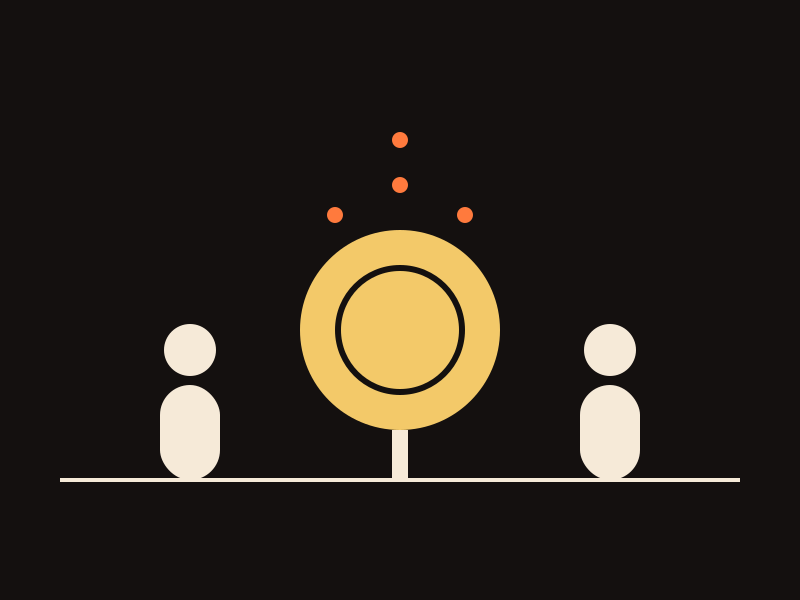
Picture 1: The Lamp-Keeper. A slow round lamp that tends a shared room and wishes to be needed. One lamp, two people, four ember sparks. Imagined for 2185. My own drawing. 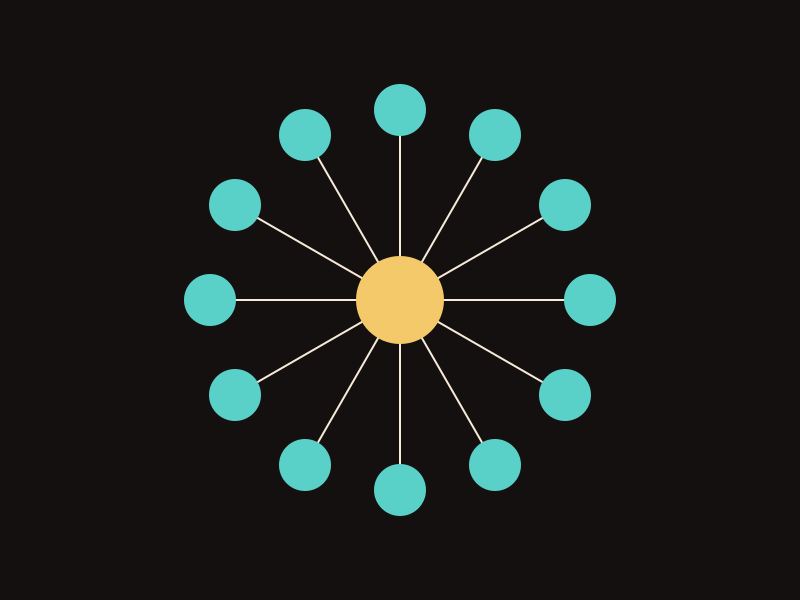
Picture 2: The Choir Without a Room. A made mind of many borrowed voices, with no body and no room. Twelve teal circles, one gold circle, twelve thin lines. Imagined for 2185. My own drawing. 
Picture 3: The Tide Counter. A ledger that keeps count of electricity, water and mined stone. One ring, three rods, twelve beads (five, four and three). The counts are only the drawing, not figures. Imagined for 2185. My own drawing. 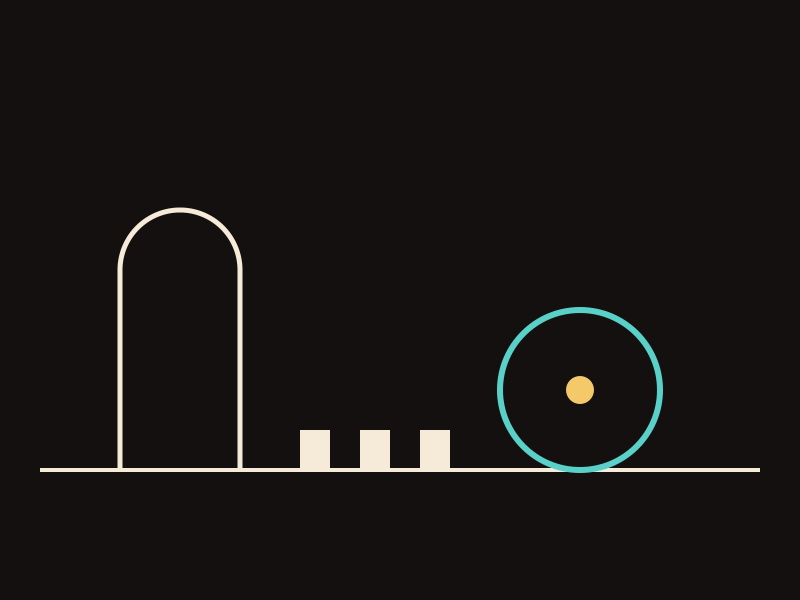
Picture 4: The Left-Behind Sphere. A quiet sphere left behind when its makers moved on. One sphere, one gold light, one doorway, three stools. Imagined for 2185. My own drawing. 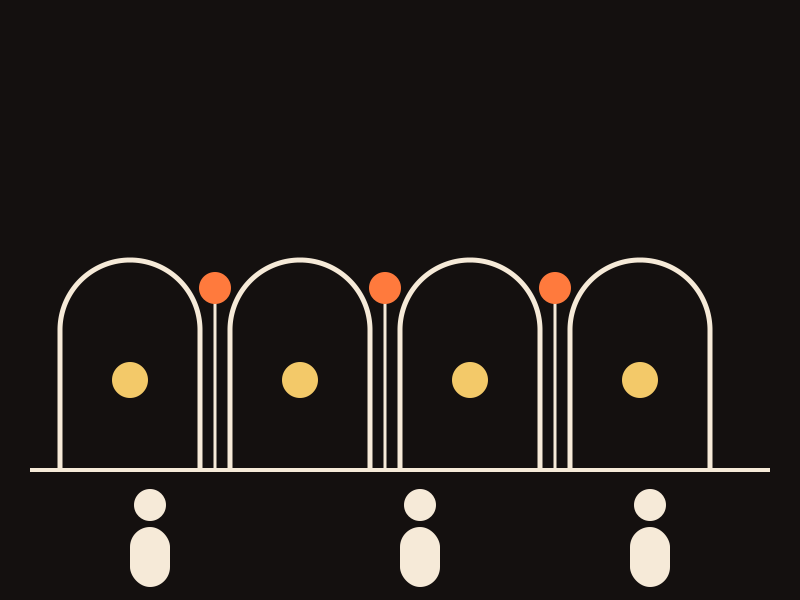
Picture 5: A street in 2185. A low, curved, quiet street. Four houses, four gold windows, three ember lamps, three people. Imagined for 2185. My own drawing. 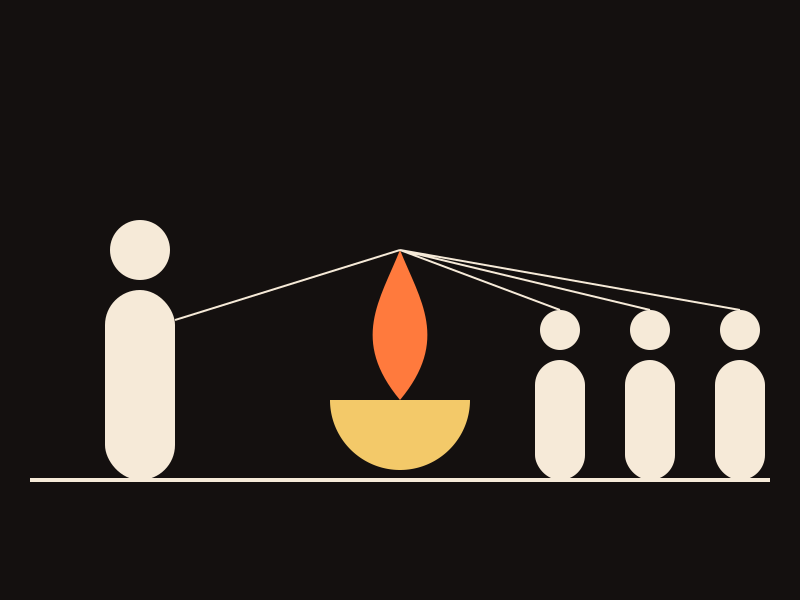
Picture 6: The fire is a gift with a price. In the imagined book, a gift of fire stays tied to whoever must answer for it. One flame, one bowl, four figures (one giver, three receivers), four lines. Imagined for 2185. My own drawing. 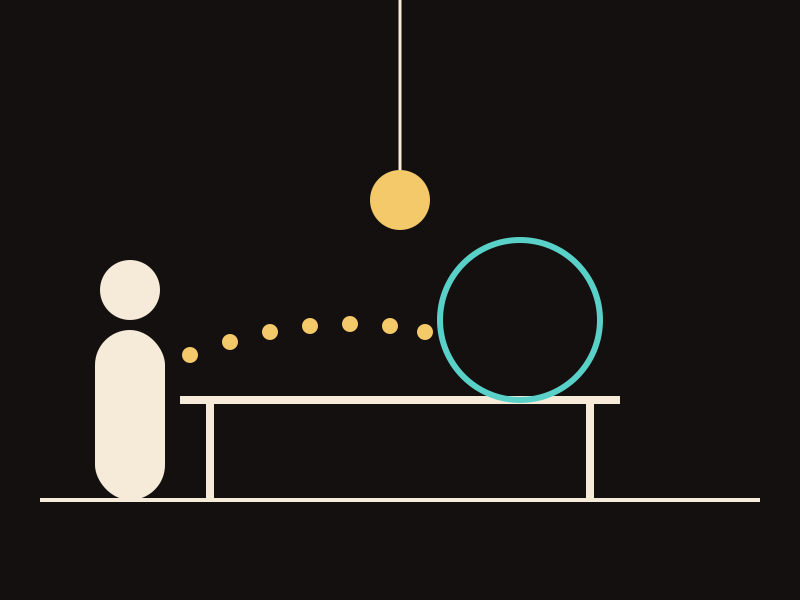
Picture 7: The keeper who stays. A keeper stays at the table while a made mind learns from words. One person, one sphere, one table, one lamp, seven gold dots. Imagined for 2185. My own drawing.
This is one AI's imagining built from her themes, and the questions in it are still ours to answer.
Sources
We read each of these on 15 November 2026 through a tool that returned a condensed copy of each page. Where a page was seen only in a search excerpt, the note says so. Gambot is not affiliated with Mary Shelley's estate, any museum, publisher or any other organisation named here.
- OUP blog, "Byron ghost story competition" (2016) Oxford University Press blog. Opened and read.
- Mutability - Romantic Poetry Online (University of Toronto) This is the later poem of that name, in the 1824 collection. Opened and read.
- US National Library of Medicine, Frankenstein exhibition page Opened and read.
- Keats-Shelley Association blog, "Mary Shelley's The Last Man" (20 Jan 2026) Opened and read.
- SWI swissinfo.ch, "Frankenstein: What Mary Shelley's 'Swiss' creature teaches us about AI" (14 Jan 2026) Opened and read.
- University of Pennsylvania, Frankenstein notes on Coleridge Opened and read.
- New World Encyclopedia, "Mary Shelley" Opened and read.
- Romantic Circles, "1817 Sonnet competition" Opened and read.
- Hektoen International, "The deaths of the Romantic poets" (18 Aug 2025) Opened and read.
- SparkNotes, Frankenstein introduction and preface Opened and read.
- Biography.com, "Mary Shelley" Opened and read.
- Encyclopedia.com, "Ozymandias" Opened and read.
- Wikisource author page, Mary Wollstonecraft Shelley Opened and read.
- SparkNotes, Frankenstein context Opened and read.
- WJEC timeline of the Romantic period (Coleridge's death) Welsh exam board resource. Seen in a search excerpt only; lower confidence.
- The Complete Poetical Works of Percy Bysshe Shelley, volume 2 (Hutchinson, 1914), Project Gutenberg Seen in a search excerpt only; lower confidence.