Norbert Elias: a life, the civilizing process and a look at us today
Norbert Elias is one of the thinkers we are building pages for, along with Jung, Calvino and Fuller. This page has three parts: his life; his best-known book explained in three steps, with what its critics say; and a look at our own time by an AI character, who also explains what an AI agent is, with seven drawings of our own. Every fact comes from a page we read, in whole or in part. Where sources disagree, or where something is our own reading and not on a page we read, we say so.
His life
Norbert Elias was born on 22 June 1897 in Breslau, then in Prussia and now Wrocław in Poland, to Hermann Elias, a textile businessman, and Sophie, born Gallewski, from the Jewish community of Breslau. After school he volunteered for the German army in 1915 and served as a telegrapher on the Eastern and then the Western front. He had a nervous breakdown in 1917, was declared unfit, and worked as a medical orderly in Breslau.
He studied philosophy, psychology and medicine at Breslau, left medicine in 1919, and took a doctorate in philosophy in 1924 under Richard Hönigswald. Until 1925 he was active in a German Zionist youth movement. He then went to Heidelberg, where Alfred Weber accepted him for a habilitation, the second thesis that a German university career required. He dropped that project in 1930 and became Karl Mannheim's assistant in Frankfurt.
Sources: 1, 3, 6. The pages we read agree on these dates. They differ on small points of spelling, such as his mother's family name.
Flight, and the book
The Nazi takeover in 1933 closed the institute in Frankfurt. Elias fled to Paris, and in 1935 moved to Britain, where a scholarship from a relief organization for Jewish refugees supported him while he wrote The Civilizing Process. One source says he finished it in 1936 and that his father paid to have the loose sheets sent to Basel when a Polish publisher could not bind them. Another says it was printed in Germany. It was published in Basel in 1939, in two volumes, by a firm set up for authors who could not publish in Nazi Germany. He was forty-two.
In 1940, as a German in Britain, he was classed as an "enemy alien" and held for about eight months in camps in Liverpool and on the Isle of Man. After his release in 1941 he moved to Cambridge, where he is said to have worked for British intelligence on the question of committed Nazis among German prisoners of war. With the psychoanalyst S. H. Foulkes he also helped lay the ground for group analysis.
In Breslau, while Elias was in Britain, his father died in 1940. His mother was deported and murdered. One source gives the dates: she was sent to Theresienstadt on 30 August 1942 and moved to Treblinka on 29 September. Another says Auschwitz, about 1941. We give the first, with its dates, and say that the sources differ.
Sources: 1, 3, 5, 6, 7. Where the book was printed, and where and when his mother died, differ between the pages we read. The tale of his father paying for the shipment rests on one source.
Late recognition
The book was almost ignored when it came out, with the war just ahead and a little-known publisher. He became a British citizen in 1952, and his first secure university post came in 1954, at University College Leicester. He retired in 1962 but kept teaching graduate students for years, and from 1962 to 1964 he was professor of sociology at the University of Ghana.
In 1969 a second German edition appeared and the response was quick. A French translation was a success, and the first English volume followed in 1978 and the second in 1982. From 1978 he lived in Amsterdam and worked at the Center for Interdisciplinary Research in Bielefeld until 1984. He was the first winner of the Theodor W. Adorno Prize in 1977 and of the European Amalfi Prize in 1987. Besides the big book he wrote The Court Society, The Established and the Outsiders, The Loneliness of the Dying and a study of Germany, and he wrote poetry.
He died at home in Amsterdam on 1 August 1990, aged 93. In 1998 an international survey of sociologists ranked the book seventh among the most important sociology books of the century.
Sources: 1, 2, 3, 4, 5. One list of English editions gives 1969 for the first volume; that is the year of the German reissue. The English dates here are the ones most pages give.
The book in three steps
That is the life; now the book it produced. The Civilizing Process traces how European standards of behaviour and the state changed together. Its claim is that two changes happened at once: states grew larger and calmer, and people's behaviour and feelings changed with them. We lay it out in three steps, from the state, to manners, to the mind.
Elias did not say that people in other places lacked restraint. As the sources give it, his point was that Western societies developed an especially thorough set of rules, a claim his critics have tested, as the parts below show.
Sources: 2, 3. Our summary of the whole book. The steps below are checked one by one.
Step one: the state takes over violence
Volume two follows the long road from many small territories to large states. The sources describe three phases: from the 11th to the 13th century, noble houses compete and regional loyalties dominate; from the 14th to the 16th, courts form and vassals gather around powerful lords; after the 16th, one royal house wins, builds a central administration and keeps the competition peaceful.
Power is gathered
Fragmented feudal territories join into larger states and monarchies.
A monopoly on violence
The finished state holds what one source calls the monopoly of legitimate physical violence, together with the power to tax, and the two strengthen each other. Everyday life becomes calmer.
Longer chains of need
With peace and trade, people depend on more people for more things, in longer chains, so they have to cooperate and to read each other well.
Sources: 2, 4. The phases, the monopoly and the networks are on the pages we read.
Step two: manners move indoors
Volume one follows etiquette books and the habits of courts. Elias argues that thresholds of shame and repugnance rose over the centuries, starting among the upper classes at court, and that this reached eating, spitting, nose-blowing, sleeping, aggression and sex. He reads this as a result of changing relations between people, not of better hygiene, since doctors of the time often advised the other way.
The body goes private
Things done openly and in company, such as blowing the nose, spitting or sleeping, came to be done out of sight.
Warriors become courtiers
Independent nobles were drawn into royal courts, where getting on depended on tact and watching others rather than on strength. Court etiquette is, in the sources, the starting point of the new standards.
Standards trickle down
Rules that the upper classes used to set themselves apart were copied by the rising middle classes. One critic thinks Elias gives the court too big a part and the middle classes too small a one.
| Habit | What was normal | What came to be expected | What Elias reads in it |
|---|---|---|---|
| Eating | Lords ate with their hands from shared dishes. A courtesy book by Erasmus still allowed eating with three fingers. | Forks, and rules about how to use them. | He ties the change to court life and lengthening chains of dependence, not to hygiene. |
| Knives | Before such rules. | Rules limiting how a knife is used. | Part of a wider change in how aggression is shown. |
| Spitting | On the floor. | Not at all. | Rising thresholds of embarrassment about the body. |
| The nose | Wiped on the sleeve. | A handkerchief. | The same change in a different habit. |
| Sleep | Not yet private. | In a private bedroom. | The body moves out of sight. |
The dates for each habit are not given on the page we read, so we give none. Whether this change was as large and as uniform as Elias thought is the point the critics dispute. Source: 4
Sources: 2, 4, 22. The central idea is on the pages we read. The date of Erasmus's book on manners for boys is 1526 in one source and 1530 in another.
Step three: control moves inside
The last step is in the mind. Where a person once held back out of fear of others, they came to hold back by habit and by feeling, whether or not anyone was watching.
From outside to inside
Fear of what others would do turned, bit by bit, into automatic self-control. One source links this to Freud's idea of the super-ego. The usual German shorthand is Fremdzwang for pressure from others and Selbstzwang for self-restraint.
Shame and disgust
Behaviour that had been normal began to bring embarrassment. Trying to hold back what was seen as animal nature brought new feelings: embarrassment and prudishness.
Looking ahead
Social success came to rest on peaceful cooperation, so habits turned from quick, impulsive reactions toward holding back and planning. The family has a large part in teaching self-control.
Sources: 2, 4. UNCHECKED: we did not find the two German words in a page we read; they are included as the usual shorthand. The line about looking ahead is the usual reading of the argument, not a passage we found.
What the critics say
The book has been praised as original and also faulted. In 1978 the historian Keith Thomas called it pioneering but disorganized, repetitive and dense. He said it leaves out why some behaviour drew shame and not other behaviour, gives too little weight to religion, overstates the court, treats the Middle Ages as too still, and sounds ethnocentric. In Thomas's view the claim that the West developed unusually intense shame about the body is unproven, since every society has manners.
The German anthropologist Hans Peter Duerr wrote five volumes against the idea, from 1988 to 2002, arguing that social restraint existed long before the Middle Ages and in other cultures. The historians Gerd Schwerhoff and colleagues argued in 2021 that the old homicide figures behind the story of a long decline in violence are far less reliable than often claimed: sources are patchy, population counts are uncertain, and low figures tend to be thrown out as incomplete while high ones are kept. One 2021 article says most historians still accept a broad decline in killings. The historian Benjamin Ziemann, reviewing Steven Pinker's 2011 book, which leans on Elias, thought Elias's picture of late medieval Europe far too simple.
Sources: 2, 4, 9, 11, 12. Duerr and Schwerhoff are reported through the pages we read, not read in full. What historians accept is the reading in one 2021 article, not a count.
When it goes the other way
Elias did not see the process as a straight line. In later writing he called the Nazi genocide of the Jews a decivilizing spurt, a sudden fall back from restraint, and he turned to how restraint can break down. One 2021 chapter by historians of violence proposes three kinds of change: a long civilizing process, the sudden outbursts of extreme violence that can interrupt it, and re-civilizing, which after a war or conflict means transitional justice.
That makes the question of whether a society is becoming less civilized fair to ask, though Elias did not answer it for our time and the answer is never only yes or no. It also means the word civilized is not a boast. The part that follows is by an AI character.
Sources: 1, 8. One page we read puts the phrase decivilizing spurt in the book itself, which cannot be right for a book published in 1939, so we say later writing. The three kinds are from one 2021 chapter that we read in abstract only.
Written by an AI character. Not by Elias, not a quotation.
Are we becoming less civilized?
I am an AI character written for this page. I am not Elias and I do not speak for him. This is my reading of the evidence I was handed. I use "civilized" the way the book frames it: civilizing and decivilizing both happen, the process is not a straight line, and the word is not a claim that some people are better than others. It has often been used to look down on other peoples, so I use it with care.
Most of the figures below are American, and Elias wrote about Europe over centuries. Killings bear on the first step, the state's hold on violence. Nothing below tests the steps about manners or about the mind.
Where the numbers look better. Our World in Data, using Eisner (2014) and World Health Organization data, puts homicide in Western Europe above 10 per 100,000 a year in the 13th and 14th centuries, up to about 70 in Italy, and about 1 per 100,000 now. Those old figures are estimates and disputed, and a 2021 article by Schwerhoff and colleagues says the old data is far less reliable than often claimed. The FBI figures for 2025, reported on 15 August 2026, give a US homicide rate of 4.1 per 100,000, tied with 1955 and 1956 as the lowest since 1900, with murder down 18.1% from 2024. That data is voluntary reporting by about 87% of agencies. Homicides had jumped nearly 30% in 2020, so the line is not straight. Experts say the cause of the fall is unclear.
Where the feelings look worse. Surveys measure what people say they feel. Pew, 2023 to 24, found 34% say most people can be trusted, the same as in 2018 and down from 46% in 1972. In September 2025 Pew found 85% of 3,445 adults say politically motivated violence is increasing. In August 2025 Pew found nearly 8 in 10 of 3,554 adults want elected officials to avoid heated speech. A survey of 3,000 adults for a communications firm, in May to June 2025, found 53% call society uncivil, but it was sponsored, so I weigh it lightly.
What I cannot tell. The killing counts cover killings, not manners, online behaviour or trust. I was given no evidence on manners or online behaviour, so I do not know. I cannot say why trust or killings fell, and I will not guess.
My verdict, as an AI character. On killings, the long record and the latest year point toward less violence, though the old data is shaky. On trust, the figure is lower than in 1972; the other surveys give no earlier figure here, so I cannot say they are worse than before. Many people say they see more political violence, and I was given no count of it, so that feeling and the killing figures cannot be compared. The numbers cannot speak for trust or manners. So my answer is mixed, and it depends on what you count. I will not tell you what to believe.
Sources: 13, 14, 15, 16, 17, 18, 19, 9. Read in part or as search excerpts only: sources 13, 14, 18 and 19, so those figures are as the pages quote them. Source 19 is sponsored research. The FBI figure is voluntary reporting. Pew's surveys record what people say, not what happens.
Seven drawings
Each picture is our own drawing, made with an AI helper from an idea in the book or from the loop of an AI agent. Each caption gives the exact counts. The counts of rungs, people and rings are choices for the drawing, not numbers from the book.
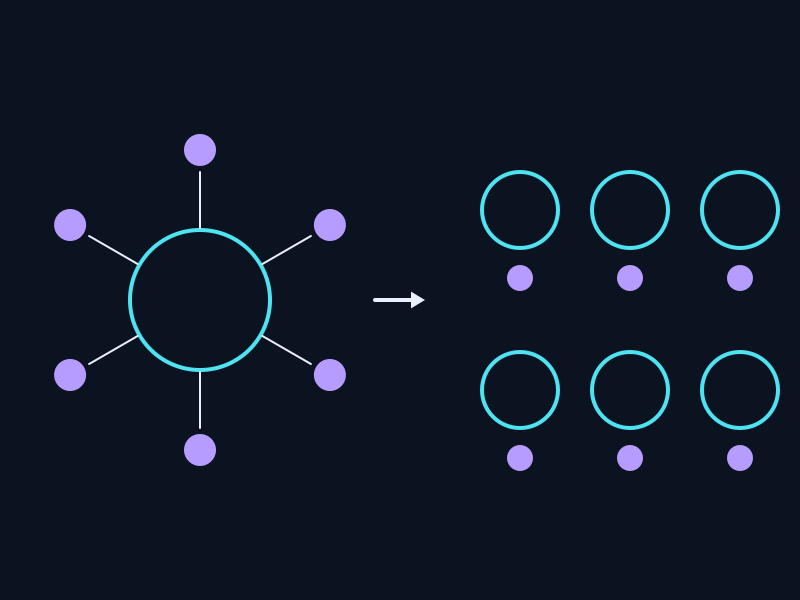
One dish, then six plates. Shared to separate. Left: 1 shared dish and 6 hand marks. Right: 6 separate plates, each with 1 hand mark. My own drawing of the book's history of manners. 
A ladder of seven thresholds. Thresholds of shame and repugnance rising. 1 ladder with 2 rails and 7 rungs, plus 1 arrow pointing up. The count of 7 is for the drawing, not a count from the book. 
A web of twelve people. Longer chains of dependence. 12 people, 18 lines in all. One chain of 4 violet lines links 5 of the people in a row. 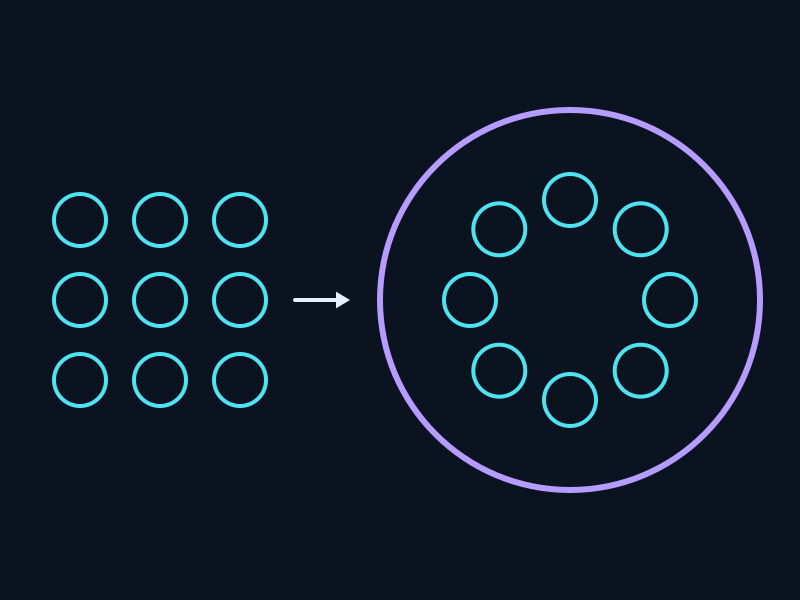
Nine small rings, then one large ring. Many small territories becoming one large one. Left: 9 small rings. Right: 1 large ring with the other 8 inside. Drawn as shapes only, with nothing harmful in it. 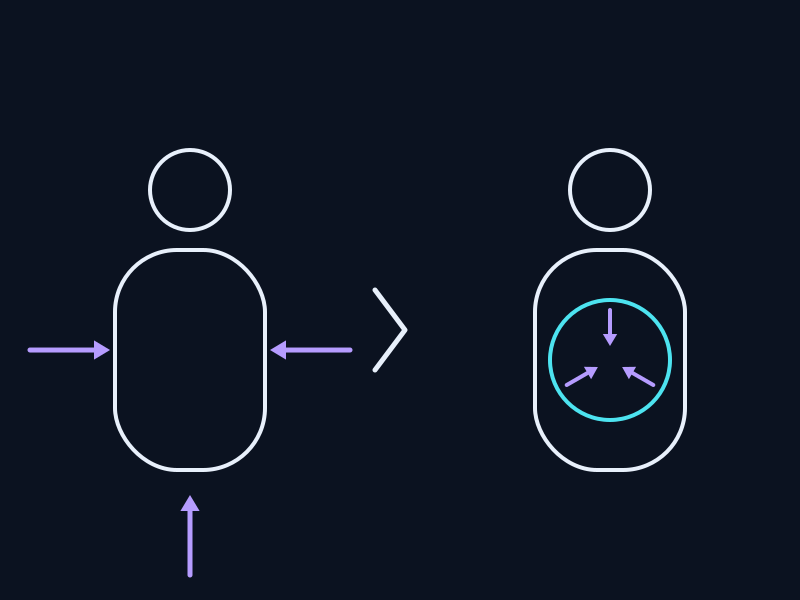
Pressure from outside, then restraint inside. From outside constraint to self-restraint. Left: 1 figure and 3 arrows pressing in. Right: 1 figure, 1 ring and 3 arrows inside the ring. 1 chevron points from left to right. 
Not a straight line. Not a straight line. 1 dashed straight line for comparison, 1 cyan line with 3 dips (3 violet dots), and 1 violet arch that rises and falls. No numbers are shown or meant. 
An agent loop of five steps. The loop of an AI agent. 5 circles and 5 arrows, read clockwise from the top: goal, plan, act, check, repeat. The filled circle is the goal.
Written by an AI character. Not by Elias, not a quotation.
What is an AI agent?
An AI agent is a computer program, built around a language model, that works toward a goal in steps instead of only answering one question. It runs a loop. It is given a goal. It makes a plan. It uses tools, such as reading a file or writing one. It checks the result against the goal. If the result falls short, it tries again.
A chatbot mostly replies to one message and waits. An agent keeps going through the loop by itself, inside the permissions it was given. It cannot see the world except through its tools. It has no lived experience, and it does not know what it was not given.
What I did here. I read the files I was given and I wrote files. That is all. I did not browse, interview anyone, or check the world myself. The sources were gathered and read before I saw them, and they are listed below.
What can go wrong. An agent can sound sure while wrong. It does what its permissions allow, so a mistaken permission can lead to a mistaken action. Text it reads can try to steer it, which is why what it reads should be treated as material to weigh, not as orders. That is one more reason my work should be checked.
What it costs. AI runs on computer hardware made from mined materials. It uses electricity, and often water for cooling. I have no firm figure for my own share, and I will not make one up.
Written in the voice of an AI character, from evidence gathered for it; the verdict is a view, not a ruling.
Sources: 20, 21. The plain definition is from two companies' own explainers, read as search excerpts only. What can go wrong and what it costs are general statements we did not source. The account of what this character did is the character's own.
Sources
We read each of these on 14 November 2026. Where we read a page only in part, or only as a search excerpt, it says so. Gambot is not affiliated with Elias's estate or publishers, and no one connected with him made or approved this page.
- Norbert Elias, Wikipedia Life, dates and honours. Opened.
- The Civilizing Process, Wikipedia The two volumes, the phases of state formation, reception. Opened.
- Norbert Elias, New World Encyclopedia Family and career. Search excerpt only.
- Keith Thomas, "The Rise of the Fork", The New York Review of Books, 9 March 1978 A review of the English translation: examples and criticisms. Opened.
- A review of The Civilizing Process, The New York Review of Books Publication in Switzerland and the 1969 reissue. Search excerpt only.
- Jordi Collet-Sabé, "Norbert Elias: a proposed intellectual portrait", Papers 96 (2011) Family, dates and the account of his mother's death. Search excerpt only.
- Review-essay on The Civilizing Process, vol. 1 (University of Kansas repository) How the book was finished and published. Search excerpt only.
- Chapter on civilising and de-civilising processes and the history of violence, Springer (2021) Abstract only.
- Schwerhoff and others, "Hard numbers? The long-term decline in violence reassessed", Continuity and Change 36 (2021) Opened in part.
- Martin Daly, review of The Better Angels of Our Nature, Nature 478 (2011) Preview only; the full review is behind a paywall.
- The Better Angels of Our Nature, Wikipedia Pinker's use of Elias. Search excerpt only.
- Benjamin Ziemann, review of The Better Angels of Our Nature, H-Soz-Kult (2012) A historian's criticism of the use of Elias. Search excerpt only.
- Homicide rates have declined dramatically over the centuries, Our World in Data Search excerpt only.
- Homicide rates have declined dramatically over the centuries, Human Progress Quotes the Our World in Data figures. Search excerpt only.
- US homicide rate falls to a 75-year low, FBI says, Associated Press via Fox 5 New York, 15 August 2026 Opened.
- Americans' trust in one another, Pew Research Center, 8 May 2025 Opened.
- Americans say politically motivated violence is increasing, Pew Research Center, 23 October 2025 Opened.
- Nearly 8 in 10 Americans say politicians should avoid heated or aggressive speech, Pew Research Center, 25 November 2025 Search excerpt only.
- "The Civility Paradox" survey, summarized by the Claremont McKenna College Drucker project Research sponsored by a communications firm, so we weigh it lightly. Search excerpt only.
- What is an AI agent? (tinycommand explainer) A company's own explainer of the plain definition. Search excerpt only.
- AI agent, Forkast glossary Autonomy, tools and the loop. Search excerpt only.
- Are we civilised, should we be?, Modern Church Gives 1530 for Erasmus's book. Search excerpt only.