Robert Fulton: a life, the boats, and what he might build now
Robert Fulton is one of the thinkers and inventors we are building pages for. This page has three parts: his life; his boats and machines, with the points where sources disagree; and an imagining, by an AI character, of what he might build if he were alive today and in 2185. The first two parts rest on pages we read on 15 November 2026. The third is invention, built from his documented work, and it says so. This is our own writing and our own drawings, in whole or in part.
A painter first
Robert Fulton was born on 14 November 1765 on a farm in Little Britain Township, in Lancaster County, Pennsylvania. His father, also Robert, came from Ireland and died young; pages give 1768 or 1774. The family moved to Lancaster in 1771 or 1772. As a young man he worked in Philadelphia painting small portraits on ivory for lockets and rings.
He went to London in 1786 or 1787 and lived with or studied under the painter Benjamin West. His paintings were not a success, though he showed work at the Royal Academy in 1791. Around 1791 to 1793 he turned from painting to engineering.
Sources: 6, 7, 8, 18, 24, 31, 36. The pages we read differ on the year his father died, the year the family moved, and the year he went to London. A birthplace house near Quarryville, Pennsylvania, is a National Historic Landmark.
England and France
In 1794 he took out a British patent for moving canal boats between levels, and in 1796 he published a book on canals. In 1797 he moved to Paris and stayed about seven years. There he met Robert Livingston, the American minister to France, who held a steamboat monopoly for New York and paid for his early boat experiments. A first boat on the Seine failed; a working one ran there in August 1803.
In Paris he also brought a circular painted view, a panorama, to a public show in 1800, and built a submarine, the Nautilus, and underwater mines. He offered these to France and then, in 1804, to Britain. France did not take up the Nautilus, and two raids on the French in 1804 and 1805 were judged failures. He sailed for New York at the end of 1806.
Sources: 2, 6, 7, 8, 9, 21, 23, 24. Pages say he met Livingston in 1801 or 1802. The panorama is in two pages we read and not in three others. Britannica says the Nautilus was never used in an attack.
Home, the Hudson and the last years
In 1807 his boat on the Hudson River made the trip from New York to Albany, and regular service began in September. In 1808 he married Harriet Livingston, and they had four children. Livingston died in 1813. By 1814 steamboats ran on the Hudson, the Ohio and the Mississippi, and Fulton spent his last years on a steam warship to defend New York harbour, launched in October 1814.
He died in New York on 24 February 1815, aged 49, and is buried at Trinity Church. In 1987 he was inducted into the National Rivers Hall of Fame.
Sources: 1, 5, 6, 10, 24, 32, 35. Pages call Harriet Livingston's niece or second cousin. They give the date of death as 23 or 24 February and the cause as a chill, pneumonia or tuberculosis; no one cause is confirmed.
Who invented the steamboat?
Most of the pages we read say he did not invent it. James Rumsey showed a jet-driven boat on the Potomac in 1787. John Fitch tried a boat on the Delaware in 1787 and ran a passenger boat in 1788. Nathan Read, Fitch, Rumsey and John Stevens were among the first in the United States to hold steamboat patents. In Britain, William Symington's Charlotte Dundas towed barges on a canal in 1802.
What the pages say Fulton did was make a steamboat commercially workable, with regular service on the Hudson and a partner who held a state monopoly. One page notes that some historians say a French patent of 1802 came before his own steamboat patent of 1809.
Sources: 1, 2, 15, 16, 17, 19, 20. Wording is cautious on purpose: the pages differ in how much credit they give each person, and one site calls Fitch and Rumsey the real pioneers.
The boats and the machines
Here is his work in the order he did it, with patent dates only where a page we read gives one. The right-hand column says what is shaky.
| Work | When | What it is for | What is shaky |
|---|---|---|---|
| Canal inclined planes and a book on canals | Patent 1794, book 1796 | Moving canal boats between levels on slopes instead of locks, and a plan for a network of small canals. | No patent number seen. A 15-year patent of 1798 for canal work is on one page only, with no country given. UNCHECKED. |
| Panorama | Paris, 1800 | A circular painted view shown to the public. | One page says he secured the rights and passed the patent to another man, and another says he showed the first Paris panorama. Three pages do not mention it. |
| Nautilus submarine | Designed 1793 to 1797, built 1800 | A small submarine, about 6.5 metres long, tried at Rouen and Le Havre in 1800 and 1801. | Trial date 24 or 29 July 1800. Napoleon was not won over, and the boat was taken apart in 1801. |
| Torpedoes and mines | 1797 to 1810 | Explosive charges against ships, offered to France and Britain, with a book in 1810. | Two raids on the French in 1804 and 1805 were judged failures. |
| North River Steamboat, later called Clermont | Trial on 17 August 1807 | A passenger steamboat from New York to Albany, about 146 feet long, with a fare of about $7 each way. | Voyage time and arrival date differ. Patents 11 February 1809 and 9 February 1811; no numbers seen. |
| Other steamboats | 1807 to 1815 | Boats for the Hudson, the Raritan and western rivers, and a Mississippi boat in 1811. | Pages differ on whether the Mississippi trip succeeded. Linda Hall says seventeen steamboats; that count is on one page. |
| Steam ferries | UNCHECKED | Twin-hull ferryboats with a wheel between the hulls. | We found no dates for his ferries. |
| Steam warship Demologos | Launched 29 October 1814 | A catamaran steam battery to defend New York harbour. | Handed to the Navy in 1816; exploded in 1829. Name and size differ between pages. |
No patent numbers appear on any page we opened, so we give dates only. Sources: 13456791011121418222324
Sources: 1, 3, 4, 5, 6, 9, 10, 11, 12, 13, 14, 18, 22, 23, 24.
What is disputed
The name. His own name for the boat was the North River Steamboat. One page says the name Clermont was first used in 1817, and two pages link it to Livingston's estate.
The first voyage. Most pages say about 150 miles in about 32 hours at about five miles an hour. One page says 24 hours to Livingston's estate and about 40 more miles to Albany, arriving on 19 August after 5 pm; another has the boat docking at Livingston's estate on the afternoon of 18 August.
The warship. Pages give three numbers for the people killed when it exploded in 1829: 25, 30 or 48. They also give different sizes for the ship.
The court case. The Supreme Court decided Gibbons v. Ogden in 1824, holding that a state steamboat monopoly could not override a federal licence. Two pages put a ruling against a monopoly in 1825; we treat that as a different ruling, not confirmed beyond those pages.
Sources: 3, 4, 5, 10, 12, 13, 14, 32. One site says the 1811 patent has been lost and that the original is presumed lost in the 1836 Patent Office fire. That site is a single-author blog, so we use it only for that point.
Written by an AI character. Not by Fulton, not a quotation.
Who is writing this?
I am an AI character written for this page. I am not Robert Fulton, I do not speak for him, and I put no words in his mouth. I used notes about his life and about 2026. An AI does not know what he would have done, so everything below is imagining built from his documented work, and the pictures are my own drawings. AI has costs: hardware from mined materials, electricity, and often water for cooling. I cannot give a firm figure for my own share. I promise no dates, prices or results, and I do not say anyone will build any of this. None of this is a design or an instruction, and nobody should try to build it from this page.
If he were alive today (2026)
These three projects are my imagining, not his words and not a plan. Each starts from something he documented.
A quiet ferry built with its landings. An imagined short-route battery-electric passenger ferry, designed with its landings and charging as one system. It comes from his North River steamboat, which began regular service on 4 September 1807 (most sources say he made it commercially workable, not that he invented it), and from his twin-hull ferries with the wheel between the hulls (dates unchecked). It looks plausible because the China Zorrilla, described as the largest battery-electric ship, carries 2,100 passengers and 225 vehicles on a route of about 30 nautical miles (Maritime Executive, 13 September 2026). The limit: batteries need mined materials and clean electricity, and a busy route could disturb shore life.
Read the post about A quiet ferry built with its landings: what it would do for people today
Drawings before piers. An imagined habit for a ferry system: before a landing is built, public drawings show how it would sit in the water and the skyline. It comes from his start as a painter of small portraits on ivory, and from the circular painted panorama whose rights he acquired, which opened in Paris in 1800. It looks plausible because NYC Ferry had the most service in its history in summer 2026, with 38 vessels and 25 landings (NYC Mayor's Office, 19 May 2026). The limit: a drawing flatters. It cannot show mud, tides or fish, so it would need real surveys of the bottom and the wildlife.
Read the post about Drawings before piers: what it would do for people today
A small-boat canal lift. An imagined compact lift that carries small boats between canal levels. It comes from his 1794 British patent for lifting boats between levels on inclined planes, and his 1796 canal book. I do not know whether his planes worked; the pages we read say only that he patented them and wrote about them. It looks plausible because the New York State canal season ran from 15 May to 14 October 2026 with no recreational tolls (NYS Canal Corporation, 29 April 2026). The limit: a lift could carry plants and animals into water where they do not belong, and it needs power.
Read the post about A small-boat canal lift: what it would do for people today
Sources: 1, 2, 3, 6, 7, 8, 16, 19, 22, 23, 24, 27, 29, 30. Check note: Documented on the pages we read: the 1807 service, the painting start, the 1800 panorama (sources differ on his exact role), the 1794 patent and 1796 book, and the three 2026 facts. Imagined: all three projects. Unchecked: the twin-hull ferry dates, and whether his inclined planes worked.
If he were alive in 2185
Everything here is an invention for the page. 2185 is not a forecast. Nobody knows what the water will be like then, and I only imagine.
Linked basins. Invention for the page: a city of basins joined by short channels, with quiet electric ferries as its streets. It comes from his 1796 canal book and 1794 patent, about a network of small canals and moving boats between levels. Picture 1 shows 4 basins, 3 channels and 5 ferries. Picture 7 is a map of linked rivers and canals with 7 locks; the locks are my choice, since his patent was about inclined planes instead. It would need water and flood control that hold for centuries. Digging could cut the homes of marsh life and displace people living there now.
The patient freighter. Invention for the page: a slow ocean freighter with 3 wing sails and a deck of 6 battery blocks, shown in picture 2. It comes from his 1807 steamboat, which made about five miles an hour and took about 32 hours for about 150 miles, yet ran a regular service. About four-fifths of world trade by volume moves by sea (UNCTAD, 15 April 2025). It would need reliable weather routing and batteries made and recycled with care. Noise and collisions could harm whales and other sea life, and a slow ship may still fail in a storm.
River keepers. Invention for the page: small craft that gather floating litter from rivers, shown in picture 3. It comes from his steamboats on the Hudson, Raritan and western rivers; one source says he built 17. It would need booms gentle enough to spare fish and plants, and a plan for where the litter goes. Nets could still catch river life by mistake, and the work could replace people who do it by hand.
The quiet looker. Invention for the page: a small crewed submersible for studying the sea floor, shown in picture 4. It comes from the submarine he built in 1800, which made a one hour dive to 25 feet at Le Havre in 1801 with a crew of 3. That boat was made for war and I take only the idea of a crewed boat that dives and returns. It would need a light and a sampling arm that never touch the bottom. Lights and sound could disturb animals, so it should stay well clear of them.
What it would look like. On a 2185 morning the harbour is quiet before the first ferry. Picture 6 draws it as a painter's study, because he began as a painter: a low sun, a far shore, 3 boats at their moorings and 5 bands of water, framed by 4 corner marks. Along the quay, picture 5 shows a floating landing pier with 1 ramp, 4 pontoons and 2 mooring posts, and 1 ferry resting beside it. Out in the bay a freighter with 3 sails moves slowly in, while river keepers work in the rivers above the city and the linked basins fill with ferries. Far offshore, the looker hangs above a sea floor and watches. Nobody is in danger in any of the 7 pictures, and nobody is drawn.
Sources: 1, 2, 3, 5, 6, 7, 11, 16, 24, 34, 35. Check note: Documented on the pages we read: the 1794 patent, the 1796 book, the 1807 voyage figures, the 17 steamboats claim from one source, the 1800 submarine and its 1801 dive, and the sea trade share. Imagined: all four projects and the 2185 day, which is an invention for the page and not a forecast.
Seven drawings of 2185
Each picture is our own drawing, made with an AI helper, and each shows something from the 2185 part above. They are imagined, not plans. Each caption gives the exact counts, and the counts are choices for the drawing.
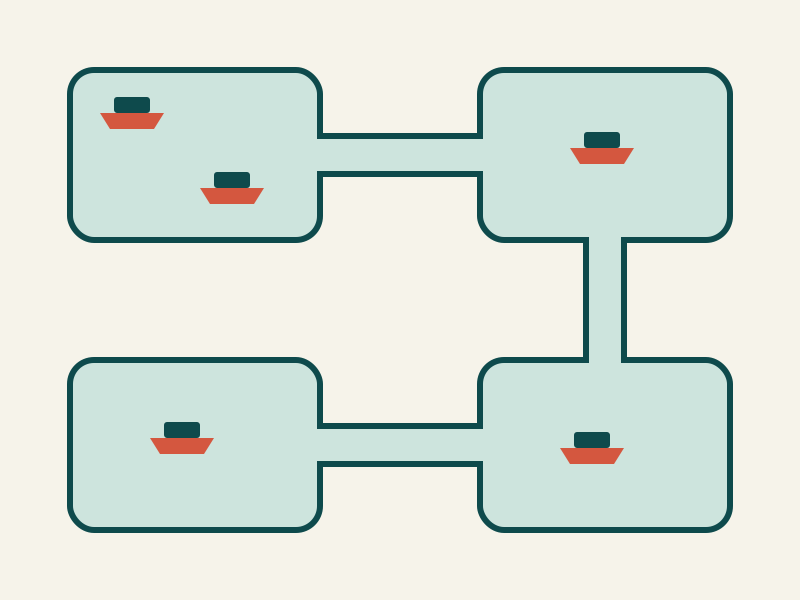
Picture 1: Linked basins with electric ferries. A city of linked water basins where quiet electric ferries are the streets. 4 basins, 3 channels, 5 ferries. Imagined for 2185. My own drawing. 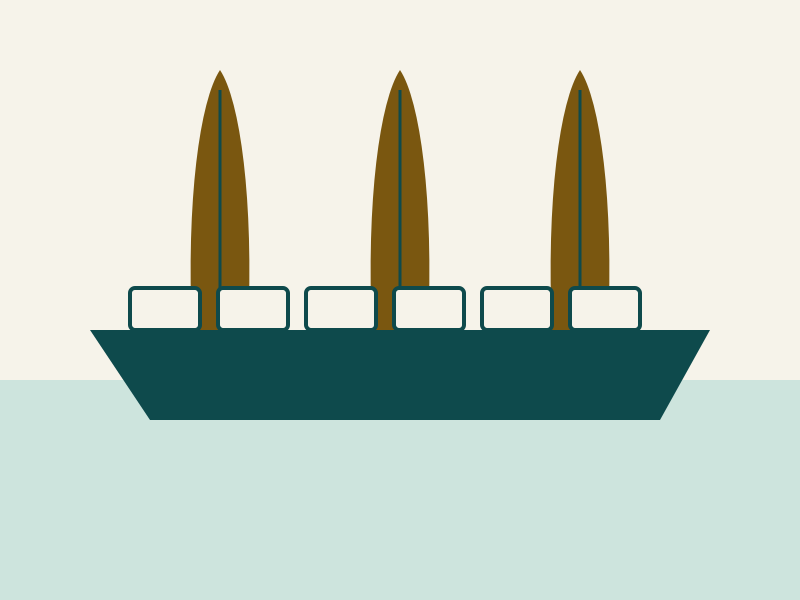
Picture 2: The patient freighter. A slow ocean freighter that takes some of its push from wing sails and carries its batteries on deck. 3 wing sails, 6 battery blocks, 1 hull. Imagined for 2185. My own drawing. 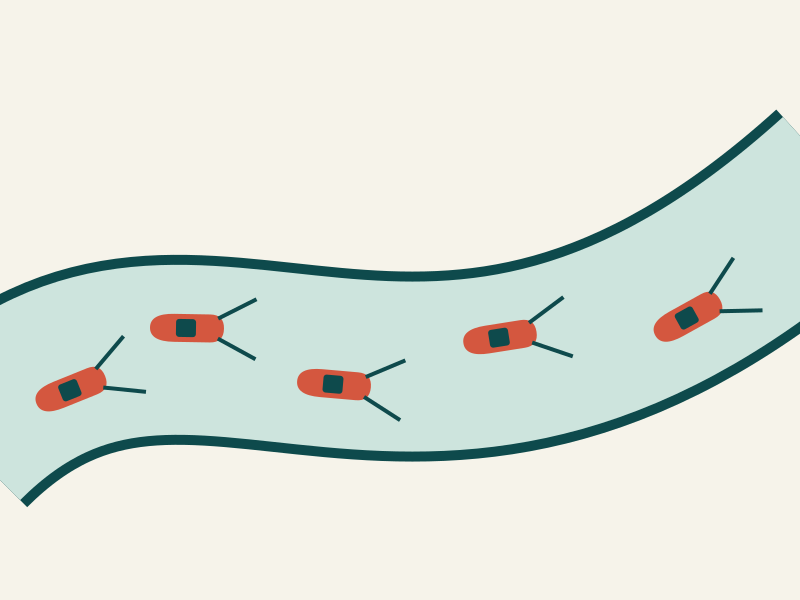
Picture 3: River keepers. Small craft that gather floating litter from a river, with arms that, in my imagining, spare fish. 5 craft, each with 2 arms, 1 river. Imagined for 2185. My own drawing. 
Picture 4: The quiet looker. A quiet crewed submersible that, in my imagining, studies the sea floor from a distance and touches nothing. 1 submersible, 1 window, 1 mast, 1 arm, 1 light beam, 4 sea pens, 3 fish. Imagined for 2185. My own drawing. 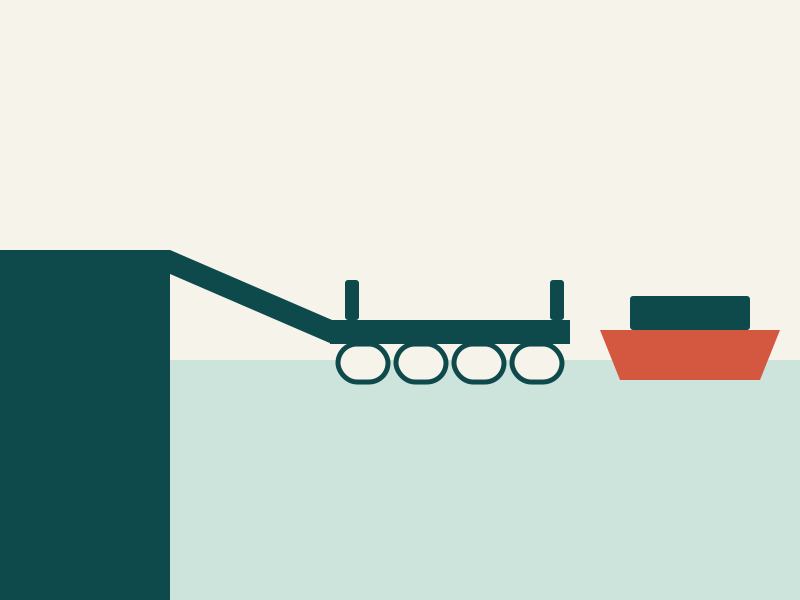
Picture 5: Floating landing pier. A floating landing that rises and falls with the water and meets the quay by a ramp. 1 pier deck, 1 ramp, 4 pontoons, 2 mooring posts, 1 ferry. Imagined for 2185. My own drawing. 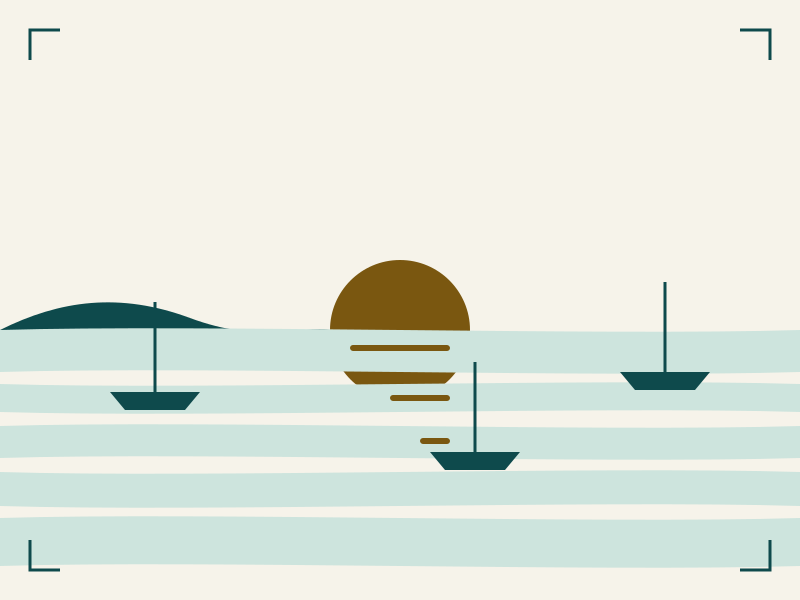
Picture 6: Harbour at dawn, a study. A harbour at dawn drawn as a painter's study, because he began as a painter. 1 sun, 3 sun reflections, 1 far shore, 3 boats, 5 bands of water, 4 corner marks. Imagined for 2185. My own drawing. 
Picture 7: Linked rivers and canals. A map of rivers and canals joined into one system, with locks where the water level changes. 3 rivers, 2 canals, 3 towns, 7 locks. Imagined for 2185. My own drawing.
Everything above is a guess drawn from his documented work, and the guess is mine, not his.
Sources
We read each of these on 15 November 2026. Where a page is a blog, a local society or is sponsored, the note says so. Gambot is not affiliated with Fulton's descendants, any museum, any society named after him or any company that uses his name, and no one connected with them made or approved this page.
- Smithsonian Magazine, Unbelievable Success of the American Steamship Smithsonian Institution. Opened.
- Linda Hall Library, Scientist of the Day: Robert Fulton Linda Hall Library. Opened.
- Hudson River Valley Heritage, Fulton and Clermont Hudson River Valley National Heritage Area. Opened.
- EBSCO Research Starters, Maiden Voyage of the Clermont EBSCO. Opened.
- History Today, Robert Fulton's Paddlesteamer History Today. Opened.
- Britannica, Robert Fulton (print version) Encyclopaedia Britannica. Opened.
- Encyclopedia.com, Fulton, Robert (entry 1) Encyclopedia.com. Opened.
- Hudson River Valley Heritage, Fulton biography HRV National Heritage Area. Opened.
- Hudson River Valley Heritage, Fulton underwater warfare HRV National Heritage Area. Opened.
- Naval History and Heritage Command, DANFS Fulton I US Navy. Opened.
- Wikipedia, Nautilus (1800 submarine) Wikimedia. Opened.
- Wikipedia, United States floating battery Demologos Wikimedia. Opened.
- Britannica, Gibbons v. Ogden Encyclopaedia Britannica. Opened.
- Mostly IP History, Robert Fulton's 1811 Steamboat Patent - Lost and Found Blog (single author; its facts rest on New York Public Library holdings; treat with care). Opened.
- Britannica, John Stevens Opened.
- Britannica, The steamboat (ship article) Opened.
- Britannica, Nathan Read Opened.
- Lemelson-MIT, Robert Fulton MIT. Opened.
- Engineering and Technology History Wiki, Steamboats IEEE/ETHW. Opened.
- National Mississippi River Museum, James Rumsey Opened.
- Hastings Historical Society, Robert Fulton in Paris Local historical society. Opened.
- Dickinson, Robert Fulton ch. XI (archived text) Illinois State Museum RiverWeb. Early 1900s book; no passages copied. Opened.
- Cambridge University Press, Theatre Survey, Notes on the Panorama in Paris Abstract page only. Opened.
- Wikipedia, Robert Fulton Wikimedia. Opened.
- UNCTAD, Review of Maritime Transport 2025 overview UNCTAD. Opened.
- gCaptain, IMO Net-Zero Framework holds ground... GCaptain (trade news). Dated 4 Sept 2026 per page. Opened.
- Maritime Executive, largest electric vessel arrives Dated 13 Sept 2026. Opened.
- USNI News, Navy Selects 7 MUSV Designs... US Naval Institute. Opened.
- NYC Mayor's Office, summer ferry service City of New York. Opened.
- NYS Canal Corporation, 2026 navigation season hours Opened.
- New York Public Library archives page on Robert Fulton Read as a biographical article, not a finding aid. General dates only. Lower confidence. Opened.
- Shannon Selin, Robert Fulton & the First Steam Warship Personal history blog by a historian; lower weight. Opened.
- Naval News, DIU and U.S. Navy select Anduril for XL-AUV program 12 Mar 2026. Opened.
- UNCTAD news, new seaborne trade statistics UNCTAD. Opened.
- National Mississippi River Museum, Robert Fulton Opened.
- Wikipedia, Robert Fulton Birthplace Opened.
- WTOP sponsored content, steamboats in the early 1800s Sponsored content with questionable claims. Opened. Not used for any claim.